Law updates
What’s changed recently
A lot has shifted lately, and much of it is progress. We track the changes that matter to Georgia patients and frame each one precisely, with sources.
Updated . We link primary sources; verify before relying on any detail.
-
Sep 3, 2026
Comments on Georgia's proposed cannabis rules close Tuesday, and here is what we asked for
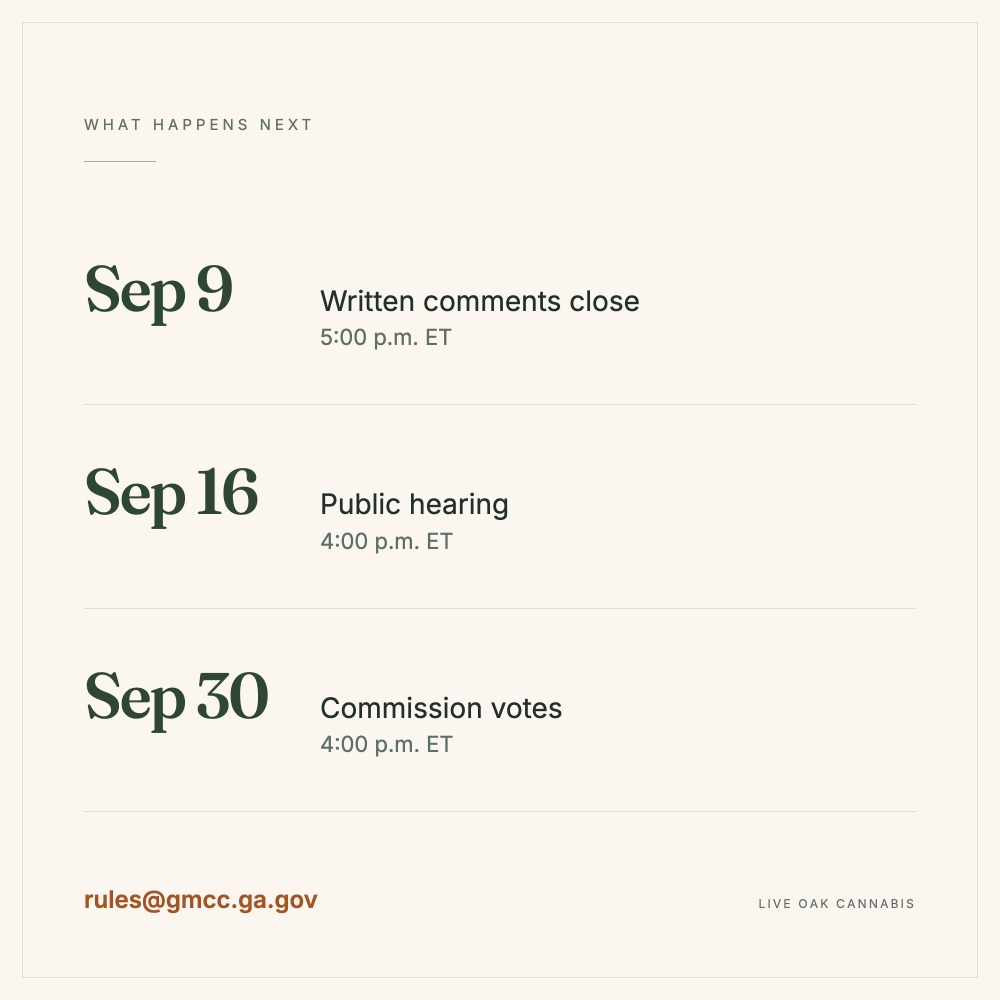
Live Oak Cannabis The public comment window on the largest rewrite of the Georgia program since 2023 closes at 5:00 p.m. ET on Tuesday, September 9. A hearing follows on the 16th and the Commission votes on the 30th. Live Oak Cannabis has filed its own comment, asking the Commission to protect veteran and senior discounts, to put a clock on product approvals, and to work toward carrying your registry card in the state's mobile ID.
The window closes Tuesday. Written comments on the eleven proposed rule notices the Access to Medical Cannabis Commission published on August 13 must reach the Commission by 5:00 p.m. ET on Tuesday, September 9, 2026. Email rules@gmcc.ga.gov, or mail GMCC, ATTN: Proposed Rules, 254 Washington Street, Fourth Floor Suite 420, Atlanta, GA 30334. That is six days from today, and it is the only point in this process where a patient’s opinion enters the official record.
Then two more dates worth keeping. A public hearing runs at 4:00 p.m. ET on Wednesday, September 16 at the Commission’s Atlanta office. Five minutes per speaker, and you have to request a slot by that same September 9 deadline, with your name, contact information, and the rule numbers you want to address. The Commission then votes on Wednesday, September 30 at 4:00 p.m. ET, by Zoom and open to the public. Nothing in these rules is law before that vote.
What is actually on the table. We read all 296 pages last month: home delivery written as a real rule that names the U.S. Postal Service, a new chapter letting Georgia universities research Georgia product, an outright ban on vitamin E acetate in vape concentrates, lab reports required to travel on the package with THC listed in milligrams, and producers allowed to sell each other harvests when one runs short. There is also one line that would bar dispensaries from dispensing “without receiving monetary consideration, including through the use of” discounts, coupons, and promotions, which reads two different ways depending on how you parse it.
We filed a comment, and here is what it says. Live Oak Cannabis submitted a public comment as a patient-facing publication. It opens by thanking the Commission, which we mean: publishing complete rule text with synopses, redlines, and clean copies within hours of the meeting where they were described is genuinely good practice, and several of the safety measures in here are things patients would never have known to ask for. The comment then makes three requests.
One, protect the discounts that reach people who need them. We support the Commission discouraging prices inflated so they can be marked back down, and said so. But a first-time patient discount, a senior discount, a veteran discount, or an income-based discount all still involve money changing hands, and Georgia patients pay cash with no insurance behind them. We asked the Commission to revise Rule 351-6-.05(6)(d) so the prohibition reaches only transactions where nothing is paid, and offered replacement language with an express savings clause. If the Commission does intend the broader ban, we asked it to say so plainly in the adopted text, so the effect is a decision someone made rather than a consequence of how a sentence gets read.
Two, put a clock on approvals. The new product registration rules say a licensee cannot use any product until it is registered and its design approved, and that any change starts the process over. That is reasonable. What is missing is a deadline: nothing in the rule requires the Commission to act within any particular time, and nothing happens if it does not. From outside, a submission under careful review and a submission sitting in a queue look identical, and the patient waiting on a product cannot tell which it is. We asked for a deemed-approved provision, thirty days with one thirty-day extension on written notice, and asked for the same on delivery plans and security plans, which are similarly open-ended.
Three, put the registry card in the state’s mobile ID. The proposed rules already accept a state mobile driver’s license at the counter. The natural next step is carrying the medical cannabis registry credential in that same state wallet, so one verified tap proves both who you are and that you are registered. Digital cannabis cards are not new; Maryland, New Jersey, New York, and Illinois all issue them. What we could not find is any state that has put the credential into its mobile driver’s license system. We flagged that this needs the Department of Public Health and the Department of Driver Services as well as the Commission, so we asked only that it note the interest and open the conversation.
We also asked it to be ambitious. In 2023 Georgia became the first state in the country to let independent retail pharmacies dispense medical cannabis. Three years on, that is simply how a large share of patients here get their medicine, and other states are studying it. The delivery rule and a wallet-carried credential are ideas of the same kind. Neither arrives tomorrow. But delivery to patients in hospitals, hospices, and personal care homes is achievable under these rules right now, without waiting on anyone in Washington, and it would reach people who currently have no lawful way to receive their medicine where they live.
You do not have to agree with us. You do not have to write anything as long, either. A few sentences from a registered patient about how a specific rule would affect you carries weight that a publication’s letter does not, and the Commission has to consider it. If you write, cite the rule number you are talking about. It makes your comment easier to place in the record, and harder to set aside. All eleven notices are on the Commission’s Commission Rules page, each with a plain-language synopsis at the front if you would rather not read the redlines.
Sources: GMCC, Commission Rules (all eleven notices) · GMCC, Commission meetings · Notice of Intent to Amend Rule Chapter 351-6 Dispensing Licensees · Notice of Intent to Amend Rule Chapter 351-4 Production Licensees · Notice of Intent to Adopt Rule 351-6-.11 Delivery · O.C.G.A. § 50-13-4, notice and comment
-
Aug 20, 2026
The rescheduling record is closed: DEA asks the judge for Schedule III, opponents argue the government changed the test
Post-hearing briefs were due August 17 in the DEA proceeding on moving all marijuana to Schedule III, and the agency used its filing to argue that marijuana no longer meets the Schedule I criteria because it has an accepted medical use and an accepted safety profile under medical supervision. Opponents, including three state governments, argue the agency reached that conclusion by abandoning its own five-part test. Nothing is decided. Chief Administrative Law Judge Derek Julius now writes a recommendation, and DEA Administrator Terry Cole makes the call.
-
What just happened, in one line. The evidentiary hearing ran June 29 through July 15. Chief Administrative Law Judge Derek Julius set August 17 as the deadline for optional post-hearing briefs, and the parties filed. The record is now closed. This is the paperwork stage, and it is the last thing that happens before a recommendation.
-
The DEA argued for Schedule III, which is still the strange part. The agency that spent decades defending Schedule I told the judge that marijuana “no longer fits the statutory requirements for Schedule I because it has a currently accepted medical use within the United States and it has an accepted safety for its use under medical supervision.” Its brief leaned on the scale of state medical programs, citing more than 30,000 practitioners treating over six million patients across 43 jurisdictions. Whatever else is true, the government’s own filing is now on the record saying the medical-use finding is met.
-
Who filed against, and what they actually argue. Smart Approaches to Marijuana filed jointly with the states of Idaho, Indiana and Nebraska. The Tennessee Bureau of Investigation, the National Drug and Alcohol Screening Association, DUID Victim Voices with Dr. Kenneth Finn, and pharmacist Dr. Phillip Drum filed separately. Their central argument is procedural rather than pharmacological: that the government applied “new and different standards, standards that are not found in the Controlled Substances Act,” and that the long-standing five-part test for accepted medical use should have governed. NDASA’s objection is narrower and more practical, warning that rescheduling would strip federal testing authority over safety-critical workers such as pilots and air traffic controllers. That is a workplace-testing argument, and it is the one most likely to survive contact with a court.
-
Read the procedural argument as an appeal being built. Nothing in these filings is aimed only at Judge Julius. A challenge that the agency applied the wrong legal standard is the kind of claim that gets raised again in a court of appeals, and there is already a separate request in the D.C. Circuit to freeze the April order. Opponents losing this stage does not end the matter, and the record they built during the hearing is the record they will point at later.
-
What happens next, and what nobody can tell you. Judge Julius reviews the briefs and the hearing testimony and issues a recommendation, which is not binding. It goes to DEA Administrator Terry Cole, who makes the agency’s final determination on the proposed rule. There is no published deadline for either step. Anyone giving you a date for this is guessing.
-
Why a Georgia patient should care about a proceeding in Washington. This case is about moving all marijuana to Schedule III. Georgia’s first-in-the-nation pharmacy dispensing does not depend on it: that rests on the separate April 2026 order already in force, which moved FDA-approved products and state-licensed medical cannabis to Schedule III. The Commission has since cited that same order as the legal footing for its proposed delivery rule. So the practical stakes here are less about whether Georgia’s program survives and more about how much federal ground it stands on. A broad Schedule III finding would make the April order look like the floor. A reversal on appeal would make it look like the ceiling, and everything Georgia has built on top of it since July 1 would be worth re-examining.
Sources: Marijuana Moment: the final briefs, with documents · Federal Register: the April 2026 order placing state-licensed medical cannabis in Schedule III · DEA: marijuana rescheduling regulatory actions
-
-
Aug 20, 2026
Four House members, two parties, one letter: what does Schedule III actually mean for patients?
Photo: Noclip via Wikimedia Commons (public domain) Reps. Dina Titus, David Joyce, Ilhan Omar and Greg Steube wrote to President Trump and three Cabinet secretaries on August 18 asking for written guidance on how the April rescheduling order works in practice. Among the questions: whether Medicare will cover medical cannabis. They asked for answers by September 30. A letter is not a policy, and none of these questions have been answered.
-
Who sent it. Reps. Dina Titus (D-NV), David Joyce (R-OH), Ilhan Omar (D-MN) and Greg Steube (R-FL) wrote on Tuesday, August 18 to President Trump, HHS Secretary Robert F. Kennedy Jr., Treasury Secretary Scott Bessent and Attorney General Todd Blanche. Two Democrats and two Republicans, which is most of the point. They asked for responses by September 30.
-
What they asked. The letter is a list of things the April order did not settle: what the rescheduling means for patients enrolled in state medical programs, whether cannabis a patient grows at home remains Schedule I or becomes Schedule III, whether Medicare and private insurers will cover or reimburse Schedule III medical cannabis, how businesses operating in both medical and adult-use markets are treated, whether Section 280E tax relief follows, what DEA registration will be required of whom, how federal enforcement will treat people and businesses outside the new registration system, and what privacy safeguards will apply to the data DEA registration collects.
-
The Medicare question is the one Georgia patients ask us most, and it is genuinely open. There is a federal program touching cannabinoids in Medicare today, and it is much smaller than the phrase “Medicare covers cannabis” suggests. The CMS Substance Access Beneficiary Engagement Incentive lets participating organizations furnish up to $500 a year of federally legal hemp products per beneficiary, runs through ACO REACH and the Enhancing Oncology Model rather than Medicare Advantage, and does not reimburse the products. We wrote that up in April and the caveats have not changed. Medical cannabis from a Georgia dispensary or pharmacy is not covered by Medicare, is not covered by private insurance, and is paid for out of pocket. This letter asks whether that will change. It does not report that it has.
-
Home cultivation is not a Georgia question, and that is worth saying out loud. Georgia does not permit patients to grow their own, so the home-cultivation item in this letter is about other states. It matters here only as a signal of how unfinished the April order is: a rescheduling that leaves the government unable to say what schedule a home-grown plant is in has some distance to travel.
-
Set your expectations correctly. This is a request for guidance, sent by four members of a 435-seat chamber, with a self-imposed deadline the administration is under no obligation to honor. Letters like this often get no reply at all. The reason to note it is not that anything changed on August 18. It is that the people who would have to legislate the fix are on record saying, four months after the order, that they do not know how it works either. If you have been trying to get a straight answer about what Schedule III means for your prescription coverage or your taxes and coming up empty, that is not you missing something.
-
The Georgia connection is the pharmacy program. Georgia is the one state whose medical cannabis moves through licensed pharmacies holding DEA registrations, which puts the DEA-registration and enforcement questions in this letter closer to home than they are anywhere else. If the administration ever answers in writing, the answers on registration and on enforcement outside the registration system are the ones to read first. We will post them if they come.
Sources: Marijuana Moment: the letter and its questions · Cannabis Business Times: coverage · Federal Register: the April 2026 rescheduling order · CMS: Substance Access Beneficiary Engagement Incentive
-
-
Aug 20, 2026
Georgia's first concentrates reach a menu: two Trulieve crumbles, one gram, 41% and 61% THC
Our daily menu check picked up two cured crumbles on Trulieve's Georgia menu this morning, the first non-vape concentrates we have recorded on any Georgia menu since we started watching. It is the category Executive Director Andrew Turnage confirmed was coming at the August 13 Commission meeting. A single gram at 61% carries roughly 610 mg of THC, which is a different order of magnitude from anything Georgia patients have been able to buy until now.
-
What showed up, and what it costs. Two products appeared under a concentrates heading on Trulieve’s Georgia menu this morning: Roll One Durban Grapefruit Crumble (Sativa), one gram, 41% THC, 3.1% terpenes, and Roll One Riddler Crumble (Hybrid), one gram, 61% THC, 3.3% terpenes. Both list a dominant terpene of β-caryophyllene and both are priced at $55. Both are cured crumble, not live resin.
-
Why we can say this is the first, and where the claim stops. We pull every Georgia licensee menu we track once a day and keep the results in version control, so the arrival of a category is something we can date rather than guess at. Trulieve’s menu carried no concentrates category at all through the check on August 18. It carried two this morning. No other licensee we track has one today: Botanical Sciences, Fine Fettle, Treevana Remedy and True Bliss all show flower, vapes, tinctures, capsules, lozenges and topicals, and nothing dabbable. What we cannot tell you is that these went on sale today rather than yesterday. Our August 19 scrape hung and was cancelled, so we have no record for that day. The honest version is that these are the first concentrates we have recorded on a Georgia menu, and they first appeared between the mornings of August 18 and August 20.
-
This is not the same thing as live resin vapes. Fine Fettle and True Bliss have carried State live resin vape cartridges and disposables for a while, and Trulieve carries fourteen vape products. Those are concentrates sealed inside a device. What is new here is a concentrate sold on its own, as a gram in a jar, which is the form the Commission has been calling extracts and concentrate based products.
-
The regulator said this was coming, one week ago. At the August 13 special called meeting, Executive Director Andrew Turnage confirmed that extracts and concentrate based products were on their way to the Georgia program. We covered that meeting and noted at the time that no concentrates appeared in any dispensary menu we track. That sentence is now out of date, seven days later. This is the ordinary sequence working the way it is supposed to: the regulator states a category is permitted, and a producer brings it to shelf.
-
Run the milligrams before you run to the store. A gram of 61% THC is roughly 610 mg of THC in one package. The 41% gram is roughly 410 mg. Georgia’s limits under SB 220 are 1,200 mg per package and 12,000 mg in a patient’s possession at any time, so both sit comfortably inside the law. That is not the point. The point is that a 1:20 tincture or a 10 mg troche puts a dose in front of you and a gram of crumble does not. This is the most concentrated product form the Georgia program has offered, and the arithmetic that made 2.5 mg a sensible starting dose has not changed just because the package got stronger. If you have only ever used oils, capsules or lozenges, treat this as a new medicine and not a stronger version of the old one, and talk to the dispensary pharmacist about how a dose is measured off a gram.
-
The law still says vaporize, not smoke. SB 220 legalized inhalation by vaporization for registered patients 21 and older, in private, and left the prohibition on smoking in place. Concentrates are a vaporized product form, and nothing about their arrival changes the line the statute draws or the fact that a Georgia registry card carries no employment protection and no protection at a traffic stop out of state. Our legal products guide predates this category and we will bring it current.
-
What we will be watching. Whether the other five licensees follow, whether the category widens past cured crumble into badder, rosin or live resin jars, and whether the independent pharmacies now dispensing get access to it or stay limited to the oil, tincture, patch, lotion and capsule forms their pharmacy rules allow. Our product listings update every morning and will show it when it moves.
Sources: Trulieve: Roll One Durban Grapefruit Cured Crumble · Trulieve: Roll One Riddler Cured Crumble · GA Access to Medical Cannabis Commission, meetings
-
-
Aug 20, 2026
The Justice Department just wrote marijuana out of its gun-rights restoration rule
A final rule published in the Federal Register today revives the dormant process for restoring federal firearm rights, and it deliberately carves marijuana out. The rule's definition of "controlled substance" no longer includes marijuana, cannabis use is no longer a presumptive reason to deny an application, and applicants and their character references no longer have to swear the applicant is not a marijuana user. The Department says it made these changes because of Hemani. It also says, in the same document, that Hemani left 18 U.S.C. 922(g)(3) standing. Both things are true and the second one still governs your Form 4473.
-
What was published, and when it bites. The Justice Department’s final rule, Application for Relief From Disabilities Imposed by Federal Laws With Respect to the Acquisition, Receipt, Transfer, Shipment, Transportation, or Possession of Firearms, ran in the Federal Register today, August 20, 2026, at 91 FR 54054. It is AG Order No. 7109-2026, docket OAG191, and it creates a new 28 CFR part 107. It takes effect September 21, 2026. Congress created the relief process at 18 U.S.C. 925(c) and then defunded it through appropriations riders starting in 1992, which left it dead on the page for more than thirty years. This rule stands it back up, run by the Office of the Pardon Attorney rather than ATF, with a $30 application fee that can be reduced or waived for indigency.
-
The three places marijuana was removed. This is the part worth reading closely, because the rule text is unusually direct about it.
- The definition in § 107.1 now reads that “Controlled substance has the meaning given the term in 27 CFR 478.11, except that it does not include marijuana.”
- The companion definition says “Unlawful user of or addicted to any controlled substance has the meaning given this term in 27 CFR 478.11, except that it excludes those whose only unlawful use of or addiction to a controlled substance consists of the use of or addiction to marijuana.”
- § 107.50(c)(5), the provision that presumptively denies an application from anyone currently “an unlawful user of, or addicted to, a controlled substance,” now points at that narrowed definition. And the Department amended the application itself so that applicants and their character references are no longer required to affirm that the applicant is not a user of or addicted to marijuana.
-
The Department said plainly why. The preamble states that it excluded from the presumption “those individuals whose unlawful drug use or addiction consists only of the use of or addiction to marijuana, in recognition of the Supreme Court’s recent decision in Hemani and in light of the many comments received regarding use of marijuana.” It went further than the case required and said so: extending the carve-out to marijuana addiction and not only marijuana use “goes beyond the facts at issue in Hemani,” but the Department concluded that sorting a “user” from an “addict” is a fact-specific inquiry it could not administer on the evidence an application would carry. Users of every other controlled substance keep the presumption of denial. Marijuana alone does not.
-
The commenters who moved this are worth naming. The preamble records that the comments on the drug provision “focused primarily on marijuana use,” that commenters pointed to the post-Bruen tradition of disarming people found to be dangerous rather than people found to be users, and that they observed that a casual alcohol user faces no such presumption. The Department engaged that argument and conceded it as to marijuana. This is what it looks like when the public comment process actually changes a rule, and it is a reasonable thing to keep in mind with Georgia’s own comment window open until September 9.
-
Now the caveat, and it is a large one. This does not legalize gun ownership for cannabis patients. The rule is a path to relief for people who are already federally prohibited. It does not touch 18 U.S.C. 922(g)(3), the statute that makes an unlawful user of a controlled substance a prohibited person, and the preamble says so twice: Hemani “preserved the prohibition in section 922(g)(3) as a general matter,” and the Court “explicitly stated that its decision should not be read to cast doubt on other provisions of section 922(g), or even on applications of section 922(g)(3) distinct from the application at issue.” Marijuana is still Schedule I for anything outside the narrow April order, a registered Georgia patient who uses cannabis is still a prohibited person under the statute, and nothing here changes how question 21(f) on ATF Form 4473 works or what answering it falsely is. If you are a Georgia patient, do not read this rule as permission.
-
What it does change for a Georgia patient, concretely. If you are federally prohibited for some other reason, most commonly an old felony conviction, and you are also a registered cannabis patient, then as of September 21 your cannabis use is no longer a presumptive reason to deny your restoration application, and you no longer have to swear you are not a user in order to file it. Before this rule, that combination was close to a dead end. That is a real and narrow improvement for a real and narrow group of people. Relief is still discretionary, still requires showing you are not likely to act dangerously and that relief is not contrary to the public interest, and is never automatic.
-
Where we come down. We have said before that a law-abiding registered patient should not have to choose between a doctor’s recommendation and a constitutional right, and we still think the honest fix is Congress narrowing or repealing 922(g)(3) rather than an agency working around its edges. But this is the federal government putting in writing, in binding regulatory text, that marijuana use is not the sort of thing that makes a person too dangerous to be armed. That is a smaller step than the headlines suggest and a larger one than it looks like on paper. If you are considering an application, talk to a lawyer who does federal firearms work. This is a summary of a rule, not legal advice, and the gap between “no longer presumptively denied” and “allowed” is exactly where people get themselves in trouble.
Sources: Federal Register: the final rule (DOJ, 91 FR 54054, Aug 20, 2026) · SCOTUSblog: United States v. Hemani · Marijuana Moment: coverage
-
-
Aug 18, 2026
Eight years of legal sales in California barely moved how many adults use cannabis. What moved was how they take it.
A UC San Diego team tracked 178,836 California adults from 2017 through 2024 and found past-year and past-month cannabis use essentially unchanged across the arrival of retail stores. What did change is how people consumed: smoking fell sharply, edible use rose, and the increase in use showed up among adults over 40 rather than young adults. The study describes one state over time with no comparison group, so it cannot tell you what legalization caused.
-
What was done. Jamie Corroon, Gretchen Bandoli, and Igor Grant, of the Center for Medicinal Cannabis Research and the Herbert Wertheim School of Public Health at UC San Diego, pulled responses from 178,836 adults in the California Health Interview Survey covering 2017 through 2024. California’s licensed retail stores opened January 1, 2018, so the window holds one year before and seven years after. They modeled each year separately, weighted to the state population, and adjusted for multiple comparisons. Published August 1, 2026, open access, funded by the CMCR under a State of California award.
-
How many people used it barely changed. Past-year use was 22.1% in 2017 and 23.5% in 2024, a gap the authors report as not statistically significant (p = 0.24). Past-month use jumped from 14.5% in 2017 to 17.7% in 2018, the first year of retail, then settled back to 15.4% by 2024, again no different from where it started (p = 0.65). How often current users consumed did not shift either: about 40% used on one to five days a month, and 37.3% used on twenty or more.
-
How people take it changed a great deal. Combustible methods, meaning joints, pipes, and bongs, fell from 71.2% of past-month users to 58.1%. Edible use climbed from 40.3% to 53.6%. Both shifts clear statistical significance comfortably. Vaping held flat near 38%, and dabbing drifted down. That is the real finding here, and it is the one the “use stayed flat” headline buries.
-
Older adults moved, young adults did not. Past-month use among adults 40 to 59 rose from 10.7% to 14.5%. Among adults 75 and older it went from 2.4% to 5.5%, more than double. Use among 18-to-25-year-olds did not change. Anyone expecting retail availability to show up first in young adults has the age gradient backwards.
-
What this study cannot tell you, and the framing to resist. This is one state watched over time. There is no comparison state, no control group, and no design element that separates the effect of opening stores from everything else happening in California between 2017 and 2024, a stretch that includes the pandemic. The authors describe trends; they do not claim causation, and neither should anyone quoting them. That matters because it is tempting to file this next to the teen-use research we have covered, which compared states that legalized against states that did not and can therefore support a causal read. This one cannot. It is weaker evidence pointed in a compatible direction, not a second pillar. The data are also self-reported, on a topic people underreport.
-
The useful way to read it. Opening stores did not appear to pull a new wave of people into cannabis. It rearranged the habits of the people already using it, away from a pipe and toward a package with a dose printed on it, and the movement that did happen came from middle-aged and older adults rather than the young ones who usually anchor the worry. Eight years is long enough for that to be more than a novelty effect. It is still one state, described rather than tested, and the next thing worth reading will be whoever runs this comparison across states.
Sources: Journal of Cannabis Research: the study (open access) · The Marijuana Herald: coverage · UCLA: the California Health Interview Survey, the underlying data
-
-
Aug 14, 2026
Georgia's proposed cannabis rules: delivery, university research, a ban on Vitamin E acetate, and a question about discounts
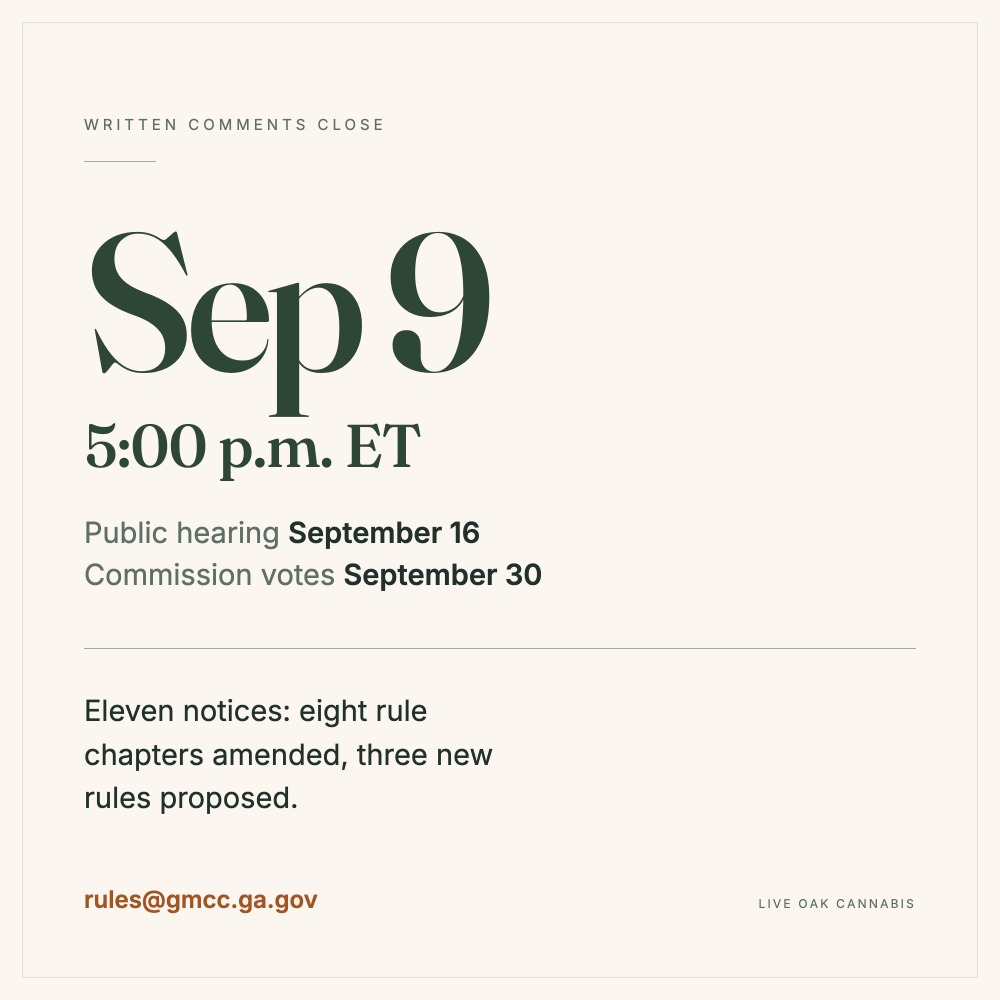
Live Oak Cannabis The Access to Medical Cannabis Commission published eleven rule notices on August 13, the largest rewrite of the Georgia program since it began. Home delivery becomes a rule and names the U.S. Postal Service. Georgia universities could research Georgia product. Lab reports would travel on the package. And one line would bar dispensaries from dispensing without payment, wording that may or may not take veteran and senior discounts with it. Written comments are due by 5:00 p.m. ET on September 9.
We said on August 13 that we would post the proposed rules as soon as they dropped. They dropped that same afternoon, and there are eleven of them: every existing rule chapter amended, plus three brand new rules. It is the largest rewrite of the Georgia program since it began in April 2023, and it is mostly the machinery of putting SB 220 into practice. We read all 296 pages. Here is what a patient would actually feel.
The date that matters is September 9. Written comments must reach the Commission by 5:00 p.m. ET on Tuesday, September 9, 2026, by email to rules@gmcc.ga.gov or by mail to GMCC, ATTN: Proposed Rules, 254 Washington Street, Fourth Floor Suite 420, Atlanta, GA 30334. A public hearing follows at 4:00 p.m. ET on September 16 at that office, five minutes per speaker, and you have to request a slot by that same September 9 deadline. The Commission votes on September 30 at 4:00 p.m. ET by Zoom. Nothing below is law yet. This stretch is the only point where a patient’s opinion enters the official record.
Home delivery becomes a real rule. New Rule 351-6-.11 would let a dispensary deliver to a registered patient, a caregiver, or a healthcare institution, once it files a delivery plan the Commission approves. The dispensary would verify your identification and registry card and keep a copy of both, confirm the amount stays inside your legal possession limit, check that the product form is one you are permitted to have, and ship only to the Georgia address printed on your state-issued photo identification. If the address on your license is out of date, fix it now. Delivery would move by certified mail or an equivalent tracked service, restricted delivery, signature required, and nobody but you, your caregiver, or a named institution employee could sign for it. The rule names three carriers: the U.S. Postal Service, a private carrier such as FedEx, UPS, or DHL, and the Commission itself or a carrier the Commission hires. The dispensary would also owe you a written procedure for what to do if the package runs late or arrives compromised.
The mail piece is still a door, not a road. We wrote that a day ago and the rule text does not change it. A Georgia rule cannot make the mail channel lawful, because the Postal Service is federal, it still treats marijuana as nonmailable, and no state uses it for cannabis today. Private carriers have their own policies and none of them currently carries cannabis either. The part most likely to work on day one is delivery to healthcare institutions, which under Georgia law means hospitals, hospices, personal care homes, ambulatory surgical centers, and emergency medical services providers. That matters. A patient in long-term care right now has no lawful way to receive product where they live, and the same rules would let a dispensary supply an institution on behalf of registered patients there, with the institution naming in writing the specific employees allowed to accept it and the dispensary checking each patient’s card and possession limit individually.
Georgia universities could finally study Georgia cannabis. An entirely new Chapter 351-9 would create research permits, letting a university hold real product through a bona fide partnership with a licensed producer. Eligibility is deliberately narrow: a University System of Georgia member or a comparably accredited independent institution, a Georgia campus maintained at least twenty years, at least 200 full-time Georgia students last year, and institutional review board approval. Permits would run up to five years and could not be transferred. Georgia permit holders could collaborate with each other, and with international institutions that comply with narcotics treaties. Read the honest part out loud, though: the rule states that a Georgia permit “does not constitute a determination of compliance with federal law,” and leaves each university to work that out alone. That is the same obstacle that has kept American cannabis research thin for fifty years, and this chapter does not remove it. One more gap worth naming: sending a published study back to the Commission would be optional, even though the stated purpose of the chapter is to inform future changes to the law.
Vitamin E acetate would be banned outright, and the testing rules get serious. Under the rewritten lab chapter, vitamin E acetate “shall not be present in any detectable quantity” in vaporizer concentrates. That is the thickening agent the CDC tied to the 2019 EVALI outbreak, which came overwhelmingly from illicit-market cartridges. Water activity joins the panel, capped at 0.65 in flower sold for vaporizing, the threshold that keeps mold from growing in storage. Heavy metal and solvent limits become product specific and much tighter for anything you inhale: chromium drops from 1,100,000 parts per billion in ingestibles to 600 in vaporized concentrate, and mercury from 500 to 100. If a cannabinoid result looks abnormal, the lab would have to screen for synthetic THC isomers and esters, the adulterants that turn up in the unregulated hemp market. Add 58 named pesticides, four Aspergillus species, and mycotoxin limits. On the integrity side, every certificate would carry the batch number, the passing certificate would reach the Commission the same moment it reaches the producer, and no certificate could be edited, reissued, or replaced after issuance without Commission approval.
Your label would finally carry the lab report. Labeling gets rebuilt into three labels. The tracking label would list every active and inactive ingredient and the amount of THC in milligrams. The safety label would carry allergen information, the warnings, and a copy of or a link to the product’s passing certificate of analysis, and it can be a QR code. Inhalable products made with terpenes that did not come from cannabis would have to say so on the package. Vape hardware gets real standards for the first time: parts that touch the product must be medical grade materials that resist bacterial growth, and a device may not contain a heating element capable of combusting product, may not be subject to an active recall, and may not mimic a shape attractive to children. The other half of that chapter is a new gate. Nothing could be sold until the product is registered with the Commission and its design approved, and any change to a design would start the process over. All of that is defensible. What is missing is a clock: the rule sets no deadline for the Commission to approve or deny, which is the difference between a new product reaching shelves in six weeks or six months.
Producers could sell to each other, which is the supply story. A new provision would let one licensed producer buy another’s harvest in wholesale quantities, with the Commission approving each transaction one at a time. Today a producer can only sell what it grew itself, so when one runs out it stays out until its own next harvest. Georgia lived exactly that this summer, when flower arrived on July 1 and disappeared. This would let a company that sold out restock from a company holding inventory. Keep expectations measured. Approval is case by case and discretionary, and the buyer has to explain the circumstances that make the purchase necessary and disclose how many plants it has growing. That reads as a relief valve for shortages rather than an open market.
New strains could reach shelves up to ten days sooner. The rules would delete the requirement that a producer notify the Commission ten days before a new strain or cultivar enters the tracking system. The producer would just keep a current list on site. Small, but if you follow specific cultivars you will notice.
Retesting could pull products off shelves, and it is worth knowing why. Lab certificates would be valid twelve months from the date the results were reported, and a producer could retest after one expires. But a retest would require every unsold unit from that batch to come back to the production facility, be resampled, and be relabeled before it could go back out. Separately, any product carrying a certificate issued before the rules take effect would have to be relabeled once that certificate expires. Only one lab could test a batch, and only one certificate could be in effect at a time, which stops a producer shopping a batch around until someone returns a better number. The upshot for patients is a recurring sweep of aging inventory back to the grower, and the items most exposed are the slow movers some people depend on precisely because they are unpopular: tinctures, capsules, topicals, unusual ratios. The counterweight is that this is the right outcome. Nobody should be sold a product whose label points at an expired certificate.
Two changes at the counter you would notice immediately. Dispensaries would accept a passport or a state mobile driver’s license as identification, alongside the usual license, state ID, and military ID. And dispensaries would stop selling paraphernalia, defined in the new rules as any device that can be used to unlawfully ignite, combust, or smoke product, that lets more than one person consume at once, or that is attractive to children. Smoking is already unlawful in Georgia, so pipes and papers are out. Vaporizer batteries appear to survive, since vaporizing is not combusting and this year’s law legalized it, but the rules never actually say so, which matters if you need a replacement.
The one line patients should read twice. The dispensing rules would bar a dispensary from dispensing “without receiving monetary consideration, including through the use of” demo or tester products, discounts, coupons, promotions, or reimbursement. Read narrowly, that only bans giving product away, because a discount still involves payment, and the Commission’s own summary describes the change as removing the ability to dispense without payment. Read broadly, veteran discounts, first-time patient pricing, senior discounts, and daily specials go with it. The text supports both readings. Georgia patients pay cash with no insurance behind them, so this is not a small question, and it is the change most likely to be softened before September 30 if patients speak up.
We are writing to the Commission, and here is what we are saying. Live Oak Cannabis is filing a public comment as a patient-facing publication, on three points. On discounts: a market free of markups invented just to be marked down is good for patients, and we support the Commission discouraging that. But first-time, senior, veteran, and income-based discounts reach the people least able to absorb Georgia’s cash prices, and the current wording could sweep them away without anyone intending it. We are asking for language that protects those patients explicitly. On approvals: we are asking the Commission to add an automatic approval trigger, so that a product or design submission meeting every published requirement is deemed approved if the Commission has neither approved nor denied it within a stated period. A queue with no clock is a queue patients wait in. On identification: since the rules now accept the state mobile driver’s license, we are asking the Commission to work toward carrying the medical cannabis registry credential in that same state wallet, so one tap proves both who you are and that you are registered. Digital cannabis cards already exist in several states, but we could not find one that has put the credential into a state mobile driver’s license system. And we close by encouraging the Commission to be ambitious. Georgia was the first state in the country to let independent retail pharmacies dispense medical cannabis, and three years on that is simply how a large share of patients here get their medicine. Postal delivery and a wallet-carried registry credential are ideas of that same kind. Neither arrives tomorrow, but a state that writes them down now is ready when the rest of the country catches up.
Read them yourself. All eleven notices, with synopses, redlines, and clean copies, are posted on the Commission’s Commission Rules page. The ones covered above are 351-6-.11 Delivery, 351-9 Research Permits, 351-4 Production Licensees, 351-6 Dispensing Licensees, and 351-7 Independent Laboratories. If you plan to comment, cite the rule number you are writing about. It makes your letter easier to place in the record, and it makes it harder to set aside.
Sources: GMCC, Commission Rules (all eleven notices) · Notice of Intent to Adopt Rule 351-6-.11 Delivery · Notice of Intent to Amend Rule Chapter 351-4 Production Licensees · Notice of Intent to Amend Rule Chapter 351-6 Dispensing Licensees · Notice of Intent to Amend Rule Chapter 351-7 Independent Laboratories · Notice of Intent to Adopt Rule Chapter 351-9 Research Permits · CDC, Outbreak of Lung Injury Associated with E-Cigarette Use (EVALI) · O.C.G.A. § 50-13-4, notice and comment
-
Aug 13, 2026
Concentrates are confirmed for Georgia, and the commission is drafting a home-delivery rule
Photo: Carol M. Highsmith / Library of Congress (public domain) At its August 13 meeting the Access to Medical Cannabis Commission confirmed that extracts and concentrate based products are coming, and described a proposed home-delivery rule that Executive Director Andrew Turnage said would make Georgia the 31st delivery state. He raised the U.S. Postal Service as a possible channel, which no state uses today. Turnage also reported 45,356 registered patients as of August 5, a 22% rise in under a month.
- Concentrates are confirmed. Executive Director Andrew Turnage confirmed that extracts and concentrate based products are coming to the Georgia program. Shelves here have carried flower, vapes, tinctures, capsules, lozenges and topicals, and no concentrates appear in any dispensary menu we track. This is the regulator saying the category is on its way, which is a different and firmer thing than a producer saying it.
- A home-delivery rule is being proposed. This is Rule 351-6-.11 Delivery, the new rule our preview of the agenda flagged as the one to watch, sitting inside the chapter that governs dispensing licensees. Turnage described it, said it would follow DEA guidelines and be built to be compliant, and said that if adopted it would make Georgia the 31st state to allow delivery of medical cannabis. For a state where large stretches of the south are more than a hundred miles from the nearest dispensary, delivery would change access more than any single new store could.
- The mail idea is the genuinely new part, and it is not settled. Turnage raised the U.S. Postal Service as a possible channel. No state uses USPS to deliver cannabis to patients today. The states that allow delivery use private couriers or vehicles the licensee operates. USPS still treats marijuana as nonmailable, and the April 2026 order moving state licensed medical cannabis to Schedule III did not change that. There is a mechanism people point to: Publication 52 does contemplate controlled substances moving through the mail where DEA registrants are involved, and Georgia’s dispensing pharmacies hold DEA registrations. But it would take the Postal Service itself to act, and it has not. If that ever happened Georgia would be the first state to do it, not the 31st. Read this as an idea a regulator raised, not a service that is coming.
- The registry is growing fast. Turnage reported 45,356 registered patients as of August 5, which he put at a 22% rise in under a month. Georgia’s patient count is reported by more than one body on different bases, so this is the Commission’s figure and its own comparison, not a number to set against a Department of Public Health count from a different week.
- Another dispensing license is open for application. The Commission announced that one more dispensing license is now available to apply for. It has not been issued and the license number was not stated. Additional licenses unlock as enrollment passes thresholds set in state law, which is why the patient figure above carries practical weight. Where a licensee chooses to put a store is a separate decision, and the recent ones have gone to metro Atlanta.
- What happens next, and when your opinion counts. The proposed rules will be posted on the Commission’s website, and the public will have an opportunity to comment before anything is adopted. That comment window is the point where a patient’s view actually carries weight. We will post the proposed rules here as soon as they drop, with the comment deadline and where to send remarks.
Sources: GA Access to Medical Cannabis Commission, meetings · USPS Publication 52, 453 Controlled Substances and Drugs · USPS shipping restrictions
-
Aug 11, 2026
The Senate killed the amendment and the hemp delay survived, on a vote that split both parties down the middle
Photo: Noclip via Wikimedia Commons (public domain) At 2:36 in the morning on August 8, the Senate voted 61 to 32 to table Sen. Ted Budd's amendment, leaving in place a four-week delay of the federal hemp THC ban. Twenty-six Republicans and thirty-four Democrats voted the same way. Both of Georgia's senators voted to keep the delay, putting them opposite Georgia's attorney general. The delay is not law yet.
- What happened. On August 8 at 2:36 AM, the Senate agreed to a motion to table Budd Amendment No. 6747 by a vote of 61 to 32, with 7 senators not voting. Tabling an amendment kills it. That leaves the four-week delay of the federal hemp THC ban in the funding bill, moving it from November 12 to December 11. The underlying continuing resolution then passed 90 to 6.
- This resolves the question we left open on August 7. Our last post on this ended with the amendment cleared for a simple-majority vote and no vote yet held. The vote has now been held, and it did not go the way a straight party-line read would have predicted.
- The coalition math is the story. Twenty-six Republicans and thirty-four Democrats, plus Sen. Bernie Sanders, voted to table. Twenty-one Republicans and eleven Democrats voted against. Majority Leader John Thune and Minority Leader Chuck Schumer landed on the same side of it. So did Ted Cruz and Rand Paul on one side, while Susan Collins, John Cornyn, Chuck Grassley and Lisa Murkowski voted the other way, alongside Democrats including Dick Durbin, Kirsten Gillibrand and Adam Schiff. Hemp is not sorting by party.
- Both Georgia senators voted for the delay. The official roll call records Jon Ossoff and Raphael Warnock each voting yea on the motion to table, which is the pro-delay position.
- That puts Georgia’s senators opposite Georgia’s attorney general. Four days earlier, Georgia’s AG was one of 35 chief legal officers who signed a bipartisan letter urging congressional leaders not to delay the ban. Georgia’s own officials are split on this, which is worth knowing before anyone tells you the state has a position.
- What the two sides said. Budd warned that the hemp industry intends to “jam us in December” and argued the products are marketed toward children. Paul framed it as an adult’s own decision, saying it is “none of their damn business.”
- One category does not get the extra four weeks. Synthetic cannabinoids that cannot be naturally produced by the cannabis plant are still set to be recriminalized on November 12 regardless of the delay. If you buy products in that category, your date has not moved.
- The delay is not law yet, and this matters. The continuing resolution still needs the House to agree and the president to sign. The House passed its own version back in June with no hemp language in it at all, so the two chambers have to reconcile. The president has publicly backed the delay, which makes a signature likely if the House takes the Senate’s text. Until that happens, November 12 is still the operative date on paper.
- What it changes for a Georgia consumer. If the delay makes it all the way through, hemp THC products stay on Georgia shelves under current state rules until December 11 instead of November 12. That is four weeks. It is a reprieve, not a reversal. The ban itself was never what this vote was about, and the real fight, over whether Congress replaces prohibition with a licensing and tax regime, is still unresolved and now lands in December with the same scrambled coalition that just showed up on this vote.
Sources: U.S. Senate roll call vote 227, Aug 8, 2026 (primary source) · Marijuana Moment (Senate votes to delay the ban) · Marijuana Moment (the vote split the usual coalitions) · The Hill (Senate tables hemp amendment)
-
Aug 11, 2026
Georgia's cannabis commission opens a rewrite of every program rule on August 13, and one of the new rules is delivery
Photo: Wikimedia Commons (public domain) The Georgia Access to Medical Cannabis Commission has called a special meeting for Thursday, August 13 at 4:00 PM ET. The agenda gives notice of proposed amendments to all eight of its rule chapters, plus three rules that do not exist today: Delivery, product recall factors, and research permits. Nothing is adopted that afternoon. The notice is what starts the public comment clock, and any patient can listen in.
- The meeting. The Georgia Access to Medical Cannabis Commission has posted notice of a special called meeting on Thursday, August 13, 2026, at 4:00 PM ET, held entirely by teleconference and livestream. There is no in-person location. The commission’s last regular meeting was July 15.
- How to listen in. Webinar ID 872 8041 8776, passcode 212990. To join by phone, dial +1 470 381 2552 or +1 470 250 9358. The commission posts the final dial-in details on its meetings page shortly before the meeting starts, so check there on Thursday afternoon in case anything changed. Audio-only listeners can dial in at 4:00 PM or shortly after, when the commission comes to order. The notice says all interested parties are invited.
- What is actually on the agenda, and it is a lot. Past the routine business, the agenda gives notice of proposed amendments to all eight existing rule chapters: 351-1 Organization, 351-2 Definitions, 351-3 Applications, 351-4 Class 1 and Class 2 Production Licensees, 351-5 Seed-to-Sale Tracking, 351-6 Dispensing Licensees, 351-7 Independent Laboratories, and 351-8 Enforcement. That is the entire rulebook. The last time the commission touched this many chapters at once was the original 2023 adoption.
- Three rules that do not exist today. Separately, the agenda gives notice of proposed new rules: Rule 351-6-.11 Delivery, Rule 351-8-.07 Factors for Product Recall, and a new Rule Chapter 351-9 Research Permits.
- Delivery is the one to watch. Rule 351-6-.11 would sit inside Chapter 351-6, which governs dispensing licensees. A delivery rule numbered under the dispensing chapter is the first formal sign that Georgia is writing a path for licensed dispensaries to bring product to patients instead of requiring every patient to drive. For a program where plenty of registered patients still live 30 or 40 minutes from a dispensary, that would be the single biggest access change since the pharmacy expansion in July.
- What we do not know yet, and will not until the text posts. We have the rule’s number and its title. We do not have a word of its language. Who could deliver, what products, to what addresses, with what ID check, whether pharmacies are included, whether it is limited by county or mileage: none of that is public yet. Anyone telling you today what Georgia delivery will look like is guessing. We will read the text when it posts and write it up then.
- Nothing is adopted on Thursday. This is the notice stage. The agenda’s closing items are announcements that the commission is posting notices of intent to adopt, which is the step that starts the formal process, not finishes it. Under Georgia’s Administrative Procedure Act the commission has to give at least 30 days’ notice before it can adopt a rule, and has to give interested people a real chance to submit written comment in between. An oral hearing has to be granted if 25 people, a government agency, or an association with at least 25 members asks for one. In 2023 the commission ran notice in September, held the hearing November 1, and adopted November 8.
- So the realistic timeline is fall, not this month. If the commission posts its notices of intent this week, the earliest plausible adoption is mid-September, and a hearing along the way could push it later. Patients who want a say on delivery should be watching for the comment window, not waiting for a press release.
- Why these meetings are worth your time. This is where the state actually decides things: licenses, application windows, and the rules that determine what you can buy and how you get it. It is public, it is free, and it is a phone call.
Sources: GA Commission — Meetings page · Notice of Commission Meeting & agenda, Aug 13, 2026 (PDF) · O.C.G.A. § 50-13-4 (Georgia rulemaking procedure)
-
Aug 7, 2026
The hemp ban's four-week delay now hangs on a simple majority, with the White House and Senate Republicans on opposite sides
Photo: Noclip via Wikimedia Commons (public domain) The Senate's stopgap funding bill would push the federal hemp THC ban from November 12 to December 11. Sen. Ted Budd filed an amendment to strip that delay out, the parliamentarian ruled on August 6 that it needs only 50 votes, and the administration's own Medicare chief wrote to senators urging them to vote it down. No vote has been held yet.
- What is actually in front of the Senate. The continuing resolution funding the government would also move the federal hemp THC ban from November 12 to December 11, a four-week reprieve. Sen. Ted Budd of North Carolina filed an amendment to strike that language and hold the original date. The underlying ban itself is not in question in this fight. Only the four weeks are.
- The procedural news is the real news. On August 6 the Senate parliamentarian ruled Budd’s amendment germane to the bill. That drops the threshold from 60 votes to 50, a simple majority, and a vote could come as soon as this week. Budd says he has picked up Democratic co-sponsors, so this is not breaking cleanly along party lines in either direction.
- The administration is lobbying against a Republican amendment. On August 7, CMS Administrator Mehmet Oz wrote to senators opposing it, saying passage “would undo significant gains that have been made to make clinically-appropriate full-spectrum hemp-derived CBD accessible” to Medicare beneficiaries. Vice President Vance had already met with Senate Republicans about the hemp language earlier in the week.
- The Medicare program Oz is protecting is smaller than it sounds. It covers up to $500 a year in hemp-derived products for eligible patients, is CBD-focused, and allows up to 3mg of total THC per serving. It runs through three risk-bearing models (ACO REACH, the Enhancing Oncology Model, and the LEAD Model) plus Medicare Advantage special supplemental benefits for chronically ill enrollees. It is a pilot, not a general Medicare benefit, and most Georgia seniors are not in it.
- Republicans are not speaking with one voice. Budd wants the ban on schedule and frames it around children’s access to unregulated THC. Ted Cruz of Texas backs the delay and has called the short extension common sense. Both are Republicans, and the White House is on Cruz’s side of this particular question.
- Georgia is already on the record, on the other side from the White House. Georgia’s attorney general was one of 35 chief legal officers, from 34 states and one territory, who wrote to congressional leaders on August 4 urging them not to delay the ban. That letter is bipartisan.
- What it changes for a Georgia consumer. If the delay survives, hemp THC products stay on Georgia shelves under current rules until December 11 instead of November 12. If Budd’s amendment passes, November 12 holds. Either way the ban itself is still coming, and the fight over the Lawful Hemp Protection Act, which would replace prohibition with a licensing regime, is a separate question that has not been resolved.
- Where this stands as we publish. The amendment has cleared the procedural hurdle and has not been voted on. Anyone telling you the delay is dead, or safe, is ahead of the record.
Sources: Marijuana Moment (Oz letter, Aug 7) · The Marijuana Herald (parliamentarian ruling, Aug 6) · The Hill (funding bill hemp delay) · The Hill (Vance meets Senate GOP) · Axios (Inside the GOP hemp wars) · Marijuana Moment (attorneys general letter)
-
Aug 6, 2026
North Carolina's hemp THC ban stalls after businesses pack the legislature
North Carolina House members tabled HB 328 on August 4 rather than vote it through, after hemp retailers and their employees filled the legislative building. The bill would have matched the federal 0.4 mg THC limit early. It will not be taken up before November, which is when the federal rule arrives anyway.
-
What happened. The North Carolina House was set to vote on House Bill 328 on August 4. Instead members tabled it. Hundreds of hemp business owners and employees filled the legislative building to lobby against it, and one chain, Apotheca, closed all fifty-plus of its North Carolina locations for the day so staff could go. The Senate had already passed the bill 37 to 6 on July 2. It is a conference report, which means the House can accept or reject it but cannot amend it.
-
What the bill would do. Cap finished hemp products meant to be eaten or inhaled at 0.4 milligrams of total THC per container, and ban synthetic or chemically converted cannabinoids. In practice that removes most hemp-derived gummies, THC beverages, vapes, delta-8 products, and THCA flower from legal sale. It also sets a 21-and-up age limit with ID checks, and addresses kratom and xylazine separately.
-
The timing is the point. That 0.4 mg cap is the federal standard arriving November 12, 2026, under the hemp redefinition signed last November. HB 328 would have brought it to North Carolina early and enforced it under state law. Tabling the bill does not stop the federal rule. It only means North Carolina will not get there first, and will not have its own enforcement machinery ready when the date comes.
-
The governor wants a third option. Gov. Josh Stein pushed back on the bill on August 4, arguing the legislature should build “a safe and well-regulated adult THC market that protects kids” instead, and criticizing the bill for legalizing kratom while, in his reading, lacking meaningful age protections. That is the same fork Congress is at: prohibit these products, or regulate them. There is a bipartisan federal bill making the regulate-instead argument, and a fight in the Senate this week over whether to delay the November date at all.
-
Why a Georgia site is covering North Carolina. Georgia’s hemp shops, smoke shops, and THC beverage sellers face the same November 12 deadline, and Georgia has not passed its own version either. North Carolina just ran the experiment of putting the question to a vote, and the answer was that the industry can still mount enough pressure to stop a bill that law enforcement leadership publicly backed. That is worth knowing before the Georgia General Assembly takes the question up.
-
What is not settled. The bill is tabled, not dead. Lawmakers can revive it or file something similar, and the reporting is that nothing moves before November. Anyone in Georgia reading this as a reprieve should keep the two things separate: the state bills are contested, and the federal deadline is on the calendar regardless.
Sources: NC Newsline: House delays the vote · WITN: lawmakers table the bill · NC General Assembly: House Bill 328 · The Marijuana Herald: Gov. Stein's statement
-
-
Aug 6, 2026
Georgia's registry nears 45,000, and the wait for a card has stretched to four weeks
The Department of Public Health counted 44,854 active patients in early August, more than 8,200 added since late June. The same surge has slowed application processing from about one week to as long as four. If you are applying now, plan around the longer wait.
-
The number. The Department of Public Health counted 44,854 active registered patients in the first days of August, up from 36,595 in late June. That is more than 8,200 new patients in about five weeks, and roughly a 22% increase over that stretch. A separate count published August 5 put the figure at 44,889. Both come from DPH, and the small gap is just a difference in when the number was pulled.
-
The practical part: applications are taking longer. DPH told the Georgia Recorder that processing has gone from about one week to as much as four weeks. Department spokesperson Nancy Shirek said the team is working to process applications as quickly as possible while still reviewing each one accurately. Nothing about eligibility has changed. There are simply far more applications in the queue than the program has ever handled.
-
What that means if you are applying. Build the delay into your plan. Your physician’s certification goes to DPH, and the card comes after DPH verifies it, so the wait starts once your doctor submits, not once you decide to apply. If you are timing a card around a treatment schedule, a work situation, or a supply you are trying not to run out of, give yourself the month. Our how to get a card walkthrough covers the steps in order.
-
Why the surge. SB 220 took effect July 1. It replaced the percentage-based potency cap with a milligram system, added flower and vaporization for patients 21 and older, opened dispensing at independent pharmacies, added lupus and inflammatory bowel disease to the qualifying list, and relaxed the “severe or end-stage” requirement on several conditions. The registry grew slowly for a decade under the old rules. It has not grown slowly since.
-
A projection, clearly labeled as one. Gary Long, CEO of the producer Botanical Sciences, estimated Georgia could eventually reach 300,000 to 400,000 patients, reasoning from the roughly 4% enrollment rates seen in established medical states. That is an industry forecast, not a state target and not a measurement. Worth knowing because capacity follows enrollment: state law lets the Commission add a dispensing license for every additional 10,000 patients past 25,000. Worth treating as a forecast all the same.
-
How this fits what we published before. In late July the same DPH series passed 41,500. This is that series continuing, not a new source or a new way of counting. The Access to Medical Cannabis Commission keeps its own “active” tally that runs lower, so if you see a smaller number elsewhere, check which agency is speaking before assuming one of them is wrong.
Sources: Georgia Recorder (via WABE): Alander Rocha, Aug 5, 2026 · Georgia Recorder: original brief · The Marijuana Herald: Aug 5 count · Georgia DPH: Medical Cannabis Patient Registry
-
-
Aug 6, 2026
Cannabis extracts blocked three Alzheimer's-linked enzymes in a lab dish. That is all it shows so far.
An Israeli team reports that four cannabis extracts inhibited enzymes tied to Alzheimer's disease, and that one protected neuron-like cells from damage. The work was done entirely in test tubes and rat-derived cell cultures. No people were involved, and nothing here tells a Georgia patient what to buy.
-
What was done. Researchers at the MIGAL Galilee Research Institute and Tel-Hai University in Israel made ethanol extracts from four cannabis chemovars, three with balanced THC to CBD ratios and one CBD-dominant. They dripped those extracts onto three enzymes in a dish and measured how much activity was suppressed. The enzymes were acetylcholinesterase (AChE), butyrylcholinesterase (BChE), and beta-secretase 1 (BACE1), all of which are involved in processes associated with Alzheimer’s disease.
-
What they found. All four extracts inhibited AChE at levels comparable to galantamine, an approved Alzheimer’s drug. Three inhibited BChE at substantially lower concentrations than galantamine required. All four reduced BACE1 activity, by 47.9% to 65.3% at the highest concentration tested. One extract, labeled C3, was then tested in PC12 cells exposed to amyloid-beta or hydrogen peroxide, and it significantly improved how many cells survived.
-
Here is the part the headline leaves out. PC12 cells come from a rat adrenal tumor. They are a standard, convenient stand-in for neurons in early screening work. They are not neurons, they are not human, and a dish is not a brain. Nothing in this study was given to an animal, let alone a person. There is no dose, no absorption, no question of whether any of this crosses the blood-brain barrier, and no clinical outcome of any kind.
-
It also is not the first time. Cannabis extracts inhibiting cholinesterases in vitro has been reported before, in more than one lab. Replication is genuinely useful and this study is a reasonable addition to that line of work. It is not a discovery, and treating it as one inflates what a screening assay can tell you.
-
Where Georgia comes in, honestly. Alzheimer’s disease is on Georgia’s qualifying conditions list, and SB 220 relaxed the “severe or end-stage” wording on several conditions. So this research touches a real Georgia patient population. What it does not do is support choosing one product, chemovar, or THC-to-CBD ratio over another. The extracts here were ethanol preparations made for laboratory testing. They are not what is on a dispensary shelf, and the concentrations used in a dish do not translate to anything you could dose.
-
The evidence that does involve patients. For dementia specifically, the trial worth reading is LiBBY, a federally funded Phase 2 study that found a low-dose CBD-dominant oil reduced agitation in 120 people with advanced dementia. That one had human participants, a control condition, and a measured outcome. It is also about agitation, a symptom, and not about slowing the disease. Neither study says cannabis treats Alzheimer’s, and anyone telling a family otherwise is ahead of the evidence.
Sources: Journal of Cannabis Research: the study (open access) · The Marijuana Herald: coverage · Alzheimer's Association: how cholinesterase inhibitors work
-
-
Jul 29, 2026
New federal survey: teen cannabis use fell again — but skip the number everyone is quoting
SAMHSA's 2025 national survey puts past-year cannabis use among 12-to-17-year-olds at 8.7%, and the coverage pairs it with 14.2% in 2011 to show a collapse. That pairing breaks SAMHSA's own rule about comparing across years. The finding survives anyway — it just rests on different evidence than the headline suggests.
-
The new number. SAMHSA released the 2025 National Survey on Drug Use and Health on July 27. Among adolescents aged 12 to 17, 8.7% reported using cannabis in the past year, and 5.0% — about 1.3 million kids — in the past month. Across everyone 12 and older, past-year use was 21.2%, or 61.6 million people.
-
The comparison being quoted doesn’t hold. Most of the coverage sets 2025’s 8.7% against 14.2% in 2011 — the year before the first adult-use states came online. It’s a tidy story and you should not repeat it. NSDUH switched to multimode collection (web plus in-person) during COVID, and SAMHSA’s own reports state that “estimates based on multimode data collection in 2021 and subsequent years are not comparable with estimates from 2020 or prior years.” The agency says the difference between an old figure and a new one could be a change in behavior, a change in how the question was asked, or both. Pairing 2011 with 2025 is exactly the comparison SAMHSA tells readers not to make.
-
Inside the window where the numbers are comparable, the picture is quieter. Past-year use among 12-to-17-year-olds ran 10.9% in 2021 and 10.4% in 2024 — SAMHSA’s 2024 report described that as “no change.” The drop to 8.7% is a one-year move in the newest release, not a four-year slide. The past-month series is the steadier one: 6.1% in 2021 down to 5.0% in 2025.
-
And 2025 was down for nearly everyone, which is worth pausing on. Young adults 18–25 went from 35.0% to 33.7%. Adults 26 and older, the one group that had been climbing (17.3% in 2021, 21.7% in 2024), came in at 20.6%. Total past-year use fell from 22.3% to 21.2%. When every age group in a self-report survey moves the same direction in the same year, a survey-year effect is at least as plausible an explanation as four separate behavior changes. One release is not a trend.
-
The conclusion still stands — on other evidence. The claim that legal access sends teen use soaring has now failed in survey after survey with methodology that is consistent across the period: Monitoring the Future and the CDC’s Youth Risk Behavior Survey both show adolescent use at or near multi-decade lows, and the state-comparison studies — including a JAMA Pediatrics analysis of roughly 898,000 students across 47 states — find no increase tied to legalization, with one large study finding a modest decrease. NSDUH 2025 is consistent with all of that. It just isn’t the knockout number the headline implies.
-
Why this matters in Georgia. We are not an adult-use state, and nothing in this survey speaks to Georgia’s registry directly. But “what about the kids” is the argument raised against every expansion here — it was raised against SB 220’s vaporization and flower provisions this spring. Patients and families making that case in front of a legislator are better served by the surveys built to track youth trends over time than by a single dramatic pairing that the issuing agency has disclaimed.
-
The honest version, in one line. Adolescent cannabis use is low and has been drifting lower through the legalization era, across multiple independent surveys. That is a real and useful finding, and it holds up. It does not need a 14.2% to stand next to.
Sources: SAMHSA — 2025 National Survey on Drug Use and Health release (Jul 27, 2026) · SAMHSA — Release of the 2025 NSDUH · SAMHSA — 2024 NSDUH annual national report (prior-year baselines and comparability caveat) · Marijuana Moment
-
-
Jul 28, 2026
Florida's registry ticked up after the Hemani gun ruling — but not the way the headlines say
A widely shared report says Florida's medical marijuana registry posted its three largest weekly gains "on record" after the Supreme Court's gun-rights decision. The weekly numbers are real, and the bump is real — but it isn't a record, it has already faded, and it says less about Georgia than it looks like it does.
- A report circulating this week says Florida’s medical marijuana registry posted its three largest weekly gains on record after the Supreme Court’s June 18 decision in United States v. Hemani — the ruling that a gun prosecution based solely on someone being a cannabis user was unconstitutional as applied. The implication is that patients who had been staying off the registry to protect their gun rights stopped being afraid.
- The weekly numbers check out. We pulled Florida’s Office of Medical Marijuana Use weekly reports directly. Active patient ID cards rose by 1,811 in the week ending July 3, 1,494 the week of July 10, and 1,013 the week of July 17 — the three strongest weeks of 2026, against a spring average closer to 1,100.
- “On record” is not right, and it isn’t close. Florida’s registry grew from about 465,000 in January 2021 to 583,000 that July — roughly 4,900 new active cards a week, sustained for half a year. The single week ending July 9, 2021 added 1,920, more than any week this July. The 2026 figures are a recent high, not a historic one.
- And the bump is already gone. The four post-ruling weeks run 1,811 → 1,494 → 1,013 → 934. The most recent week is back inside Florida’s ordinary 2026 range, which has bounced between roughly 300 and 1,475 all year. Whatever happened in early July was a short pulse, not a new baseline.
- One more caveat worth knowing. “Qualified patients with an active ID card” is a net number — new sign-ups minus cards that lapsed. Florida’s own 2026 series went down in several weeks, including a drop of about 1,900 in one March week. A rise can reflect a renewal cycle as easily as a rush of newcomers, and Florida’s reports never say why anyone enrolled. The outlet that ran the story says so too, to its credit.
- So is there a Hemani effect? Probably a modest one. The strongest evidence is what didn’t happen: Florida’s spring weeks were flat, and the three best weeks of the year landed in the fortnight after the decision. The weakest part of the case is the timing — the first full week after the June 18 ruling added only 1,418, and the peak came two weeks later, which is a slower fuse than a fear-lifting headline would predict.
- What it means for Georgia. We can’t run the same test here. Florida is a clean read precisely because nothing else changed there; Georgia’s registry jumped past 41,500 in the same window, but ours is dominated by SB 220 — vaporization, a milligram-based limit, new qualifying conditions, and pharmacy dispensing all landing July 1. Any Hemani effect in Georgia is buried under a much larger one.
- The honest takeaway for patients. The federal gun ban is still on the books; Hemani was an as-applied ruling, not a repeal, and Congress has not rewritten 18 U.S.C. § 922(g)(3). What the Florida numbers suggest is that some people were weighing that risk against their own health and are now deciding differently. That’s a real shift, and it’s worth naming without inflating it — the case for restoring these patients’ rights doesn’t need a fake record to stand on.
Sources: The Marijuana Herald · Florida OMMU — weekly updates (primary source) · SCOTUSblog — United States v. Hemani
-
Jul 25, 2026
A bipartisan bill would scrap November's hemp THC ban and regulate the products instead
Reps. Andy Barr and Angie Craig filed the Lawful Hemp Protection Act on July 22 — the first serious off-ramp from the federal ban that takes effect November 12. It would redefine hemp at 1% total THC, set a 21-and-up age limit, tax the products, and replace prohibition with a licensing regime. Its sponsor says the White House is behind it; the White House hasn't said so itself.
- What was filed. On July 22, Rep. Andy Barr (R-KY) and Rep. Angie Craig (D-MN) introduced the Lawful Hemp Protection Act. It is the first bipartisan attempt to undo the hemp redefinition signed last November — the one that recriminalizes almost every hemp THC product on November 12, 2026 by capping finished goods at 0.4 mg of total THC per container.
- What it would do instead. Hemp would be redefined at up to 1% total THC by dry weight (up from 0.3%), and the per-container standard would be replaced with per-serving potency limits. The Secretary of Health and Human Services would have twelve months to set those limits; if HHS doesn’t act, defaults kick in at 5 mg per serving for oral products and 50 mg per serving for inhalables and topicals.
- It is a regulatory regime, not a free pass. Sales restricted to 21 and older. Federal permits for manufacturers and wholesalers. Labeling — per-serving and per-package THC, driving and pregnancy warnings, a drug-test warning, a QR code to the certificate of analysis, and no health claims — effective 180 days after enactment. Products must be grown, processed, and packaged in the United States. Synthetic and artificially modified cannabinoids are banned outright, HHC, THC-O-acetate and THCP among them.
- And it is taxed. A 5% tax on the sale price of consumable hemp products, another 5% on manufacturers’ annual sales revenue, and for beverages a federal excise of 5 cents per milligram of THC. Revenue funds a new oversight trust fund; one percent of the beverage tax goes to the Highway Trust Fund for impaired-driving enforcement. Hemp beverages would also be forced into an alcohol-style three-tier system, with no company allowed to sit on more than one tier.
- What this means for Georgia’s shelves. Georgia already regulates consumable hemp under SB 494 — 21-and-up sales, edibles capped at 10 mg per serving and 300 mg per container, beverages at 10 mg of total THC per 12 ounces, and no retail hemp flower. Nearly all of that becomes federally illegal on November 12 under current law. This bill would keep it legal — but note the fit isn’t exact: the 5 mg default oral serving ceiling is half of what Georgia currently permits in a beverage, unless HHS sets a higher number.
- The part nobody in the hemp trade is happy about. Because the 1% figure is total THC and counts THCA, the bill would effectively wipe out the THCA flower market, which is one of the largest hemp categories in the Southeast — those products routinely test far above 1% total THC even while meeting the current 0.3% delta-9 rule. Attorney Rod Kight, who supports the bill overall, calls this its central gap. Others argue the fallback potency ceilings are too low for an adult market and that the three-tier structure hands wholesalers a gatekeeping role they haven’t earned.
- About that White House endorsement. The claim that the administration backs the bill comes from Barr’s own press release. There has been no statement from the White House, and Marijuana Moment reported on July 24 that administration officials have reservations about the inhalable-product provisions. Treat “Trump-backed” headlines accordingly until someone at the White House says it on the record.
- It also carries a Medicare provision, and the reporting doesn’t agree on what that provision is — some accounts describe it as codifying the existing CMS hemp pilot, others as a Medicare Advantage supplemental benefit. Those are materially different things. The pilot that actually exists runs through traditional-Medicare ACO models, not Medicare Advantage, and caps eligible oral products at 3 mg of total THC per serving. We’ll update this once the bill text is public.
- Odds are not good, and the calendar is short. The House Farm Bill passed without any language delaying the November ban. Barr’s earlier attempts to attach this as an amendment were blocked from a floor vote by the Rules Committee. Sen. Ted Cruz has called the path uphill, and the Marijuana Policy Project puts passage at difficult — though a narrower carve-out for beverages remains plausible. Barr himself has described the opposition as strange bedfellows: parts of the alcohol industry, parts of the marijuana industry, and legalization opponents, all pulling the same direction for different reasons.
- If you’re a registered Georgia patient, none of this touches your card. The November ban and this bill both govern hemp — the CBD and delta-8 and THC-drink aisle at the gas station and the bottle shop. Georgia’s medical cannabis program runs on a separate track, under SB 220 and the state’s licensed producers, dispensaries, and participating pharmacies. What happens in November changes what you can buy off a retail shelf. It does not change what you can buy with a low-THC oil card.
Sources: Marijuana Moment (bill filed) · Marijuana Moment (White House support questioned) · Rep. Andy Barr — press release · U.S. Hemp Roundtable · Kight on Cannabis (legal analysis of the gaps) · Congress.gov CRS — the November redefinition
-
Jul 25, 2026
Two new pain studies — and one finding that cuts against how most people shop
A 243-person study of edible cannabis and chronic low back pain found the relief tracked with THC, not CBD — and that more CBD blunted THC's effect. Separately, a small placebo-controlled trial in Brazil found full-spectrum CBD oil eased burning mouth syndrome. Neither is practice-changing, and both are worth reading carefully.
- The bigger of the two. Published in Biomedicines in July 2026, researchers followed 243 adults with chronic low back pain for 14 days as they used edibles they bought themselves on the legal market. Participants fell into three groups by product type — CBD-dominant, THC-dominant, or a balanced THC/CBD ratio — and filled out daily surveys on pain and on what they had taken.
- What it found. Pain was significantly lower on days people used cannabis — but only in the THC-dominant and balanced groups. CBD-dominant products showed no comparable effect. About 36.6% of the balanced-ratio users reported at least a 30% reduction in pain over the study period, which is the threshold pain researchers generally treat as clinically meaningful. Higher THC doses tracked with lower pain the following day.
- The finding worth sitting with: higher CBD doses weakened THC’s pain effect. That runs against a lot of shelf advice — and against the instinct many new patients have to reach for the highest-CBD, lowest-THC thing on the menu because it feels like the cautious choice. On this measure, for this kind of pain, it wasn’t the more effective one. That is one study on one condition, and it says nothing about side effects, tolerance, or what happens past two weeks.
- What this study cannot tell you. It is observational, not a trial. Nobody was randomly assigned anything; people chose their own products, which means the groups may have differed in ways the study couldn’t account for. Use was self-reported. Potency came off the product label rather than independent lab testing. And fourteen days is a snapshot, not a course of treatment.
- The second study is much smaller. Researchers at the Federal University of Paraná in Brazil tested full-spectrum CBD oil against placebo in 26 adults with burning mouth syndrome, a chronic orofacial pain condition that is notoriously hard to treat. Dosing started at 10 mg daily and was titrated up to 50 mg where symptoms persisted. Median pain intensity in the CBD group fell to zero on a 10-point scale, against above six on placebo, with the gap reaching significance by the third assessment. Quality-of-life measures improved as well.
- And its limits are serious. Twenty-six people, twenty-five of them women. Assignment was alternating rather than randomized, and only participants were blinded — not the researchers. The team enrolled fewer than half the 56 participants their own power calculation called for, which means the trial was underpowered by its authors’ own standard. One participant dropped out with headache, dizziness and weakness after a single dose; the investigators judged that a likely nocebo response, which is a judgment call. Symptoms returned 15 to 20 days after people stopped.
- Where Georgia comes in. Intractable pain is on Georgia’s qualifying-conditions list, and SB 220 broadened it as of July 1. Chronic low back pain and burning mouth syndrome are not named conditions in their own right — whether a given case rises to intractable pain is a call for a Georgia-licensed physician, not a checkbox. What has changed is the product side: with the old 5% THC cap gone, the balanced and THC-dominant ratios these researchers were actually measuring are now available to registered patients here in legal forms, which was not true a month ago.
- How much weight to give this. Not much on its own, and that’s the honest answer. One observational study cannot establish that THC treats back pain, and a 26-person single-blind trial cannot establish that CBD treats burning mouth syndrome. What they do is add to a body of evidence and point at a question worth a real randomized trial. If you’re managing chronic pain in Georgia, the useful move is to bring the ratio question to your physician — not to change what’s in your cabinet because of a headline.
Sources: Biomedicines (low back pain study) · The Marijuana Herald (low back pain) · Oral Surg Oral Med Oral Pathol Oral Radiol (burning mouth syndrome trial) · The Marijuana Herald (burning mouth syndrome)
-
Jul 24, 2026
Georgia's medical cannabis registry passes 41,500 patients
The Georgia Department of Public Health now counts more than 41,500 active registered patients — up roughly 22% since early June, with nearly 5,000 signing up in the three weeks since the SB 220 expansion took effect.
- The Georgia Department of Public Health now reports more than 41,500 active registered patients in the state’s medical cannabis program — a new high for a program that spent years measured in the low tens of thousands.
- The growth is steep and recent: DPH’s own count ran roughly 34,000 in early June, 36,703 by the end of June, and past 41,500 by late July — about a 22% jump in under two months, with nearly 5,000 of those sign-ups coming in the three weeks after the SB 220 expansion took effect July 1.
- The timing points to the expansion as the driver. SB 220 dropped the old “low-THC” cap for a milligram-based system, added flower and dry-herb vaporization for patients 21 and older, expanded the list of qualifying conditions, and opened dispensing at independent pharmacies statewide — all changes that took effect July 1.
- A note on the number. This figure comes from the Department of Public Health’s registry. Our earlier posts cited the Access to Medical Cannabis Commission’s own “active” tally — 33,314 when it approved the state’s 19th dispensing license in early July, then about 35,000 by mid-July — and the two agencies don’t always count the same way, so the leap isn’t a clean apples-to-apples reading. What is clean is DPH’s own month-over-month series, and it shows real, fast growth.
- More capacity is built to follow the patients: state law lets the Commission add a dispensing license for every additional 10,000 patients past the 25,000 mark, and the Commission has signaled it will likely open a new application window for its production licensees. Rising enrollment is the lever that widens access.
Sources: The Marijuana Herald · MJBizDaily
-
Jul 21, 2026
A federally funded trial finds THC and CBD ease agitation in advanced dementia

Photo: NIH Image Gallery / NIH Clinical Center — public domain The Phase 2 LiBBY trial, funded primarily by the National Institute on Aging, found that a low-dose, CBD-dominant oral oil significantly reduced agitation in 120 hospice-eligible people with dementia — a result that lands squarely on two conditions Georgia's registry already covers.
- Results from the LiBBY trial — Life’s End Benefits of cannaBidiol and tetrahYdrocannabinol — were presented for the first time at the Alzheimer’s Association International Conference in July 2026. It is a Phase 2, multicenter, randomized, double-blind, placebo-controlled study, which is the design that actually tells you something.
- 120 participants with Alzheimer’s disease or another dementia took part. All were eligible for or receiving hospice care and had clinically significant agitation. Mean age was about 80; 55% were women, 58% came from underrepresented racial and ethnic groups, and three-quarters lived in the community rather than a facility — study visits were conducted where participants lived, across ten medical centers.
- What they took: an oral oil, dissolved in a digestible carrier — 2mg THC with 100mg CBD twice daily for the first week, then 4mg THC with 200mg CBD twice daily through week 12. That is a CBD-dominant, roughly 1-to-50 formulation at a low THC dose. It bears no resemblance to a recreational product, and that distinction matters when reading the headlines.
- The results. On the Cohen-Mansfield Agitation Inventory, the treatment group improved 6.27 points more than placebo at week 2 — the trial’s primary endpoint — and 8.23 points more at week 12. By clinician rating, 87.2% of the treatment group had improved at week 12, against 23.6% on placebo. The lead investigator, Dr. Jacobo Mintzer of the Ralph H. Johnson VA Healthcare System and the Medical University of South Carolina, noted that a response rate near 90% is rarely seen in dementia trials.
- The honest caveats, because they matter here. These findings were presented at a conference and have not yet completed peer review. It is a Phase 2 trial in a narrowly defined population — advanced, hospice-eligible dementia — so it says nothing about early-stage disease or about dementia patients generally. And while overall adverse events were similar between groups (46.7% vs. 42.4%), serious adverse events were more common in the treatment arm — 23.3% versus 11.9% — though investigators concluded none were related to the study medication. The Alzheimer’s Association continues to recommend non-drug approaches as the first line for agitation.
- Why this is Georgia news. Both “Alzheimer’s disease (severe or end-stage)” and hospice care are on Georgia’s qualifying-conditions list, and since SB 220 took effect July 1 the state’s products are no longer held under the old 5% THC cap. A low-dose, CBD-dominant ingestible oil is exactly the kind of product Georgia’s program already permits.
- What this is not is a product you can ask for by name at a dispensary or pharmacy counter. The trial used a specific research formulation on a supervised protocol, in a frail population where dosing is delicate. If you’re caring for someone with advanced dementia in Georgia, this is a conversation to have with their physician and hospice team — not a label to match on a shelf. Funding came primarily from the National Institute on Aging at NIH, with the Alzheimer’s Association supporting the open-label extension now underway, so more data is coming.
Sources: Alzheimer's Association (AAIC 2026 release) · LiBBY Study · Marijuana Moment
-
Jul 21, 2026
Senate Democrats file a descheduling bill — and Republicans are said to be drafting one too
Photo: Noclip via Wikimedia Commons (public domain) Days after the DEA's rescheduling hearing closed, Senate Democrats filed the Cannabis Administration and Opportunity Act to remove marijuana from the Controlled Substances Act entirely. A separate report says House Republicans are preparing their own descheduling bill — though no Republican bill has been filed, and none is sponsored today.
- On July 16, Senate Democrats filed the Cannabis Administration and Opportunity Act. Led by Sens. Cory Booker and Chuck Schumer with more than a dozen Democratic colleagues, it would require the attorney general to finalize a rule removing marijuana from the Controlled Substances Act within 180 days — descheduling, not rescheduling.
- The bill builds a full federal framework around that: a new FDA Center for Cannabis Products overseeing manufacturing, labeling and retail, with roles for ATF and the Alcohol and Tobacco Tax and Trade Bureau; federal excise taxes starting at 5% for smaller producers and 10% for larger ones, rising over time; automatic expungement of low-level federal convictions within a year, with resentencing petitions for those still serving; banking access for licensed businesses; and a bar on cannabis convictions being used to deny federal benefits or housing. States could still prohibit cannabis entirely, but could not block transport between states where it’s legal.
- Then, on July 21, The Marijuana Herald reported that several congressional Republicans are preparing a descheduling bill of their own — one that would strike marijuana from the CSA and leave each state to prohibit or regulate as it chooses, without the social-equity provisions Democratic bills carry. It’s expected in the House before the midterms.
- Here is where we have to be careful, because the distinction matters. That Republican bill has not been filed. It has no number, no text, and no named sponsors — the report rests on two congressional staffers speaking anonymously. As of today, no Republican in Congress sponsors a descheduling bill at all. So this is not yet “bills from both parties.” It is one bill filed and one bill reported.
- That said, the report is genuinely significant, and it’s worth saying why. A Republican-authored descheduling bill would be a first. The bipartisan energy so far has gone to narrower vehicles — the STATES 2.0 Act, which leaves cannabis policy to the states, already draws support from both parties, while the MORE Act’s 75 House sponsors are Democrats. A GOP bill that removes cannabis from the CSA outright would move the Republican position from “let states decide” to “end federal prohibition,” which is a different thing.
- The timing is the story. All of this lands within days of the DEA’s administrative hearing on broader rescheduling wrapping up, where even witnesses called by the opposition conceded cannabis meets the Schedule III standard. Post-hearing briefs there are due August 17, with no announced date for a decision after that. Congress moving on descheduling while the executive branch works through rescheduling is the most activity the federal question has seen at once.
- What it would and wouldn’t mean for Georgia. Descheduling would not legalize anything here — Georgia law governs what Georgia patients can buy, and our program remains medical-only. But three federal knots that currently bind Georgia patients would loosen. The Democrats’ bill would bar federal workplace drug testing outside law enforcement and security roles, which speaks directly to the job-protection gap first responders and other patients face. It would settle banking for licensed operators. And per Marijuana Moment’s reporting, it would head off the November 12 hemp recriminalization that currently threatens Georgia’s THC beverage market.
- There’s a fourth, and for many readers it’s the biggest. The federal gun ban at 18 U.S.C. § 922(g)(3) reaches anyone who is an unlawful user of a controlled substance as defined by the CSA. Remove marijuana from the CSA and that hook appears to come out with it — a cleaner fix than Hemani, which was decided narrowly and as-applied and left lower courts without much guidance. We’ve said before that Georgia patients shouldn’t have to choose between their medicine and their Second Amendment rights. Descheduling is the version of that fix that wouldn’t depend on how the next judge reads the record.
- Now the sober part. The CAOA has been introduced before without advancing, and it faces a Republican-controlled Congress. The GOP bill isn’t on paper yet. Neither may get a vote this year. We’re reporting movement, not predicting outcomes — and we’ll say so just as plainly if either bill stalls.
Sources: The Marijuana Herald (Democrats' bill) · The Marijuana Herald (Republican bill reported) · Marijuana Moment
-
Jul 18, 2026
States begin protecting first responders who use medical cannabis — Georgia isn't one of them
Maryland, Ohio and Connecticut have all moved this year to help firefighters, EMTs and paramedics get treatment for PTSD — including the first employment protections for first responders who are registered cannabis patients. PTSD qualifies in Georgia, but a Georgia card still won't protect your job.
- Several states have moved this year to open treatment options for first responders with PTSD, and one of them went further than any state has before — Maryland, whose new law takes effect in October 2026, bars employment discrimination against firefighters, EMTs, paramedics and rescue workers who are registered medical cannabis patients. The protection covers a worker who tests positive for cannabis metabolites but shows no impairment on the job.
- That distinction — metabolites versus impairment — is the whole ballgame. Cannabis metabolites can linger for weeks after use. A test that finds them proves someone consumed at some point; it does not show they were impaired at work. Maryland is among the first states to write that difference into law for first responders.
- Ohio took a different route: Gov. Mike DeWine signed a measure in June creating a Post-Traumatic Stress Injury Commission, which reviews applications from eligible first responders and helps cover the cost of treatment.
- Connecticut expanded a Yale University pilot studying psilocybin-assisted therapy. It had been limited to veterans, retired first responders and healthcare workers; the state has now opened it to any resident 18 or older who meets Yale’s clinical criteria. A Missouri bill that would have let veterans and first responders access psilocybin and ibogaine through approved research studies advanced but stalled when the legislature adjourned in May.
- Where Georgia stands. PTSD (patients 18 and older) is on Georgia’s qualifying-conditions list and remains there under SB 220. So a Georgia firefighter or paramedic with PTSD can legally register, and since July 1 can access a far wider range of products than before.
- What Georgia does not have is any job protection to go with it. Georgia is an at-will employment state, and its medical cannabis law has never required an employer to accommodate a registered patient or limited an employer’s ability to drug test and act on the result. SB 220 did not change that. A Georgia paramedic can hold a valid registry card, follow their doctor’s guidance exactly, and still be fired over a positive test.
- This is the same gap we noted after the Pentagon’s memo to service members: access keeps expanding while the rules governing people’s livelihoods stay put. It falls hardest on exactly the people the program was expanded to reach — veterans, first responders, and others carrying trauma from work they did on everyone else’s behalf. Maryland’s law is a template, and Georgia lawmakers now have one to look at ahead of the 2027 session. We’ll keep following it.
Sources: Marijuana Moment · Ogletree Deakins (Georgia drug testing)
-
Jul 17, 2026
The court fight to pause rescheduling is a live risk to Georgia's pharmacy program
A drug-testing trade group and a biopharmaceutical company are asking the D.C. Circuit to freeze the April order that moved state-licensed medical cannabis to Schedule III. That order is the federal footing Georgia's first-in-the-nation pharmacy dispensing stands on — and the Justice Department is fighting the request.
- Start with why this matters here. Georgia pharmacies dispensing medical cannabis is a national first, and it did not happen on state law alone. In November 2023 the DEA told Georgia pharmacies to stop, on the grounds that a DEA-registered pharmacy may only dispense controlled substances in Schedules II through V — and cannabis was in Schedule I. What changed that was the April 2026 federal order moving FDA-approved and state-licensed medical cannabis products into Schedule III. That order is the federal ground the pharmacy counter stands on.
- That order is now being challenged. Three lawsuits have been consolidated before the U.S. Court of Appeals for the D.C. Circuit: one from Smart Approaches to Marijuana and the National Drug and Alcohol Screening Association (NDASA), a drug-testing industry group; one from a coalition including MMJ International Holdings, a cannabis-focused biopharmaceutical company; and one from the attorneys general of Indiana and Nebraska. Louisiana withdrew from that third suit.
- They aren’t just asking the court to overturn the order — they’re asking it to freeze the order now, while the case proceeds. NDASA and MMJ filed a reply brief on July 16 pressing that request, arguing they face irreparable harm and that rescheduling will stimulate the industry and increase misuse. NDASA points to the cost of revising drug-testing policies; MMJ says it loses a competitive advantage after eight years and roughly $10 million spent on federal compliance.
- The Justice Department is opposing the stay, and is not being subtle about it. DOJ argues the challengers lack standing: NDASA offers only generalized speculation about effects on the drug-testing industry, and MMJ can’t claim competitor standing because it has no FDA-approved product and is “not a current market competitor.” In DOJ’s framing, these are “pocketbook interests” — protecting screening revenue and a market position — not the interests Congress wrote the Controlled Substances Act to serve.
- What a stay would actually mean is untested, and we’re not going to pretend otherwise. No court has granted anything. No agency has said Georgia pharmacies would have to stop dispensing. But the honest read is that the Schedule III order is the thing that answered DEA’s 2023 objection, and a court freezing that order would put the question back open — for the roughly 120 independent pharmacies now dispensing statewide, and for the patients who rely on them because the nearest licensed dispensary is an hour away.
- This is separate from the rescheduling that’s been in the news. The DEA administrative hearing that wrapped up in July concerns whether all marijuana moves to Schedule III; post-hearing briefs there are due August 17, with no timeline announced for a decision after that. The D.C. Circuit case is about the narrower April order that is already in effect — the one Georgia’s program is built on.
- Nothing has changed for patients today. Pharmacies and dispensaries are operating normally, and there is no action for anyone to take. We’re flagging it because it’s the most consequential thing currently pending for Georgia’s access model, and because a patient reading about “rescheduling lawsuits” deserves to know which one actually touches their pharmacy. We’ll report it plainly if the court rules either way.
Sources: Marijuana Moment (stay request) · Marijuana Moment (DOJ response) · Federal Register (April 2026 order)
-
Jul 16, 2026
Pentagon reminds service members: cannabis is still off-limits, rescheduling or not

Photo: Air Force Staff Sgt. Brittany A. Chase / U.S. Department of Defense (public domain) The Department of War issued a memo warning troops that using or possessing marijuana remains punishable under military law — a reminder that federal rescheduling didn't change the rules for people in uniform, and that veterans and service members still lack the access other patients now have.
- The Department of War (the Pentagon) issued a memo reminding service members that marijuana use and possession “remain punishable” under military law — even after the administration’s move to reschedule medical cannabis to Schedule III.
- The point is narrow but important: rescheduling changed the drug’s federal classification, not the separate rules that govern the military. Active-duty personnel are still bound by the Uniform Code of Military Justice, which treats cannabis use as an offense regardless of what a state program allows.
- This is the same pattern patients keep running into — federal reform moving in one place while other rules lag behind. It echoes the firearms fight after Hemani: a step forward for civilian patients doesn’t automatically reach everyone.
- There’s still real work to do here. Many Georgia patients are veterans — Trulieve’s first expanded-program sale on July 1 went to a retired Army veteran — and the people who served are among those most likely to benefit from medical cannabis for pain, PTSD, and other conditions. Yet service members and, in practice, many veterans navigating VA care still can’t get the same access Georgia’s registry now extends to other residents.
- Closing that gap will take action at the federal level — from the Department of War and the VA down to the statutes themselves. Until then, we’d urge active-duty readers to understand that the military’s rules haven’t changed, and we’ll keep following the effort to make sure those who served aren’t left behind as access expands.
Sources: Marijuana Moment
-
Jul 15, 2026
Two weeks in: ~120 Georgia pharmacies now dispensing, most of the state within a 30-minute drive
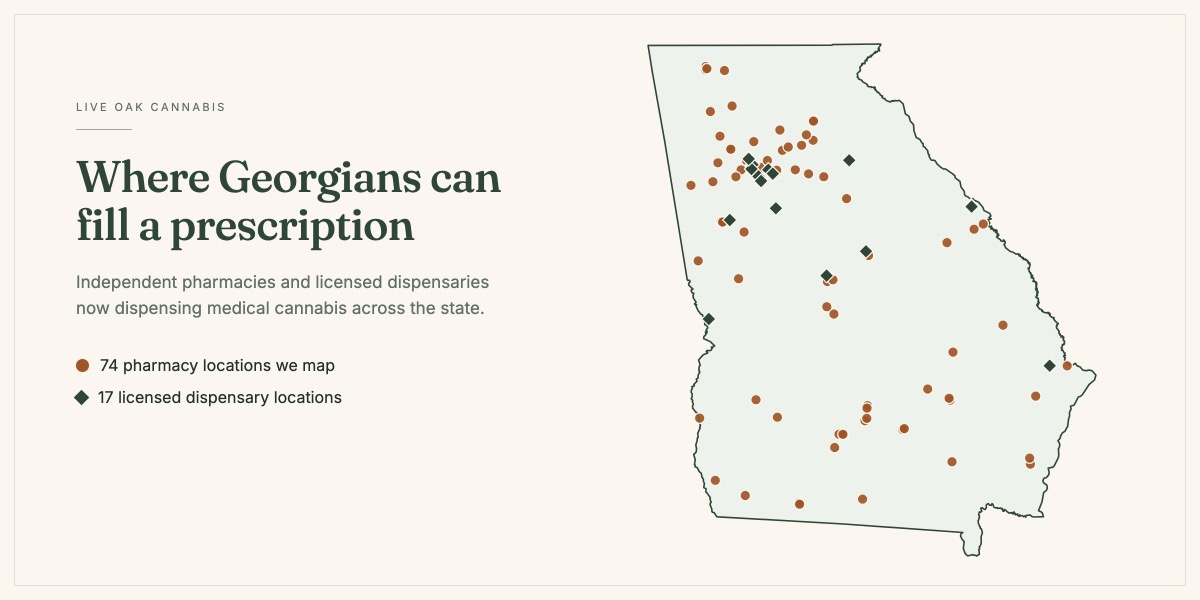
Live Oak Cannabis map. Locations are the ones we've verified by hand — the state's pharmacy count is higher, and we add each one as we confirm it. State outline: U.S. Census TIGER (public domain). Two weeks after SB 220 took effect, roughly 120 independent pharmacies are dispensing medical cannabis across Georgia — putting an estimated 90% of residents within a half-hour drive — as the patient registry climbs toward 35,000.
- Two weeks into the SB 220 expansion, roughly 120 independent pharmacies are now dispensing medical cannabis statewide — a network that has grown quickly since independent pharmacies were cleared to participate.
- With that footprint, an estimated 90% of Georgians now live within a 30-minute drive of a place that can dispense their medicine, a dramatic change from a program that once relied on a handful of licensed dispensary storefronts.
- Georgia’s registry has climbed to roughly 35,000 cardholders, up from the 33,000-plus counted when the commission approved the state’s 19th dispensing license earlier this month.
- SB 220, which took effect July 1, is what opened the door: it dropped the “low-THC” cap for a milligram-based system, added flower and dry-herb vaporization for patients 21 and older, expanded qualifying conditions, and removed distance-from-schools restrictions that had kept many pharmacies out.
- The pharmacy model — ordinary drugstores dispensing state-regulated cannabis alongside the licensed dispensaries — remains a national first, and the early scale-up suggests access is widening faster than the dispensary-only era ever allowed.
-
Jul 15, 2026
DEA rescheduling hearing wraps — even opponents concede cannabis fits Schedule III
The two-week DEA hearing on moving all marijuana to Schedule III closed with witnesses called by the opposition acknowledging under oath that cannabis meets the legal standard — and testimony exposing a divide inside the government.
- The DEA’s historic administrative hearing on whether to move all marijuana — not just the FDA-approved and state-licensed medical products already reclassified in April — from Schedule I to Schedule III concluded on July 15, after roughly two weeks of testimony.
- The most striking moment: even expert witnesses aligned with the opposition acknowledged that cannabis satisfies the legal test for Schedule III classification. Testimony also surfaced an internal split within the government over its own medical-use analysis.
- The proceeding had drawn criticism because the seven participants selected to testify appeared to be uniformly against rescheduling — yet the record still cut toward the case for reform.
- What happens next: the Chief Administrative Law Judge will issue a recommended decision. Parties then have 20 days to file exceptions before it goes back to the DEA for a final ruling. This is a step in a long process, not the finish line.
- Why it matters for Georgia: April’s order already placed state-licensed medical cannabis in Schedule III, which is what let Georgia’s pharmacies begin dispensing. A broader rescheduling wouldn’t change Georgia’s medical program directly, but it would ease research, reduce the tax burden on the wider industry, and further chip away at the Schedule I framework that has shaped every rule patients live under.
Sources: Business of Cannabis · Cannabis Business Times
-
Jul 15, 2026
After Hemani, Congress weighs how to fix the cannabis-user gun ban
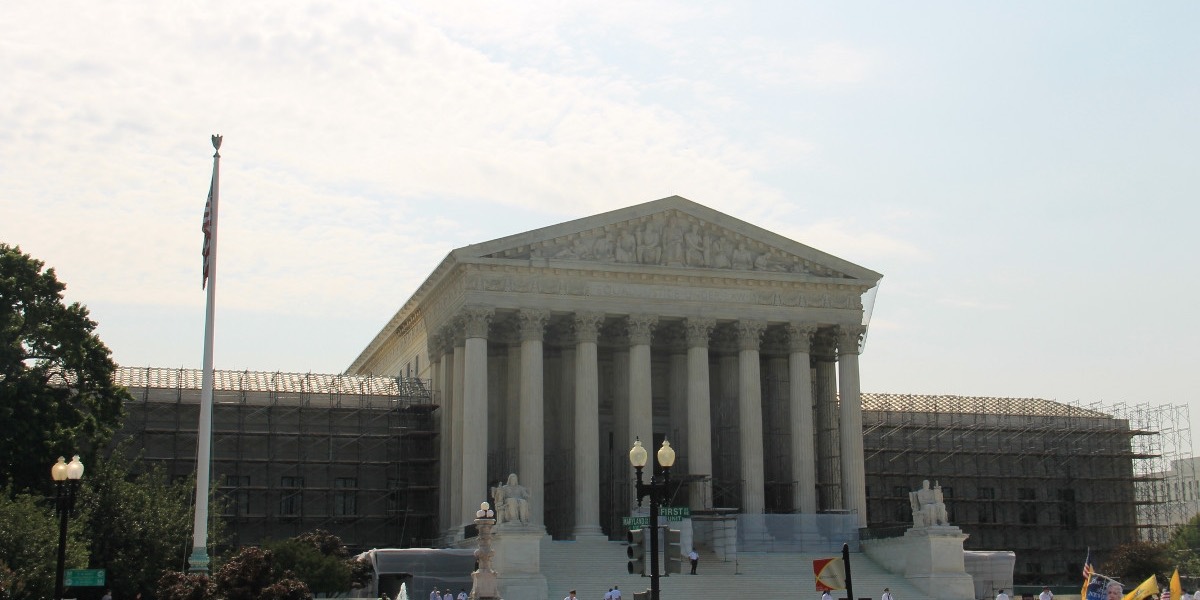
Photo: Architect of the Capitol (public domain) A new Congressional Research Service report lays out how lawmakers could rewrite the federal law that bars cannabis users from owning firearms — following the Supreme Court's Hemani ruling, which found that prosecution unconstitutional.
- A new Congressional Research Service report walks lawmakers through options for reforming 18 U.S.C. § 922(g)(3) — the federal law that bars anyone who uses marijuana or other controlled substances from owning or possessing a firearm.
- The backdrop is June’s Supreme Court decision in United States v. Hemani, which held that applying the ban to a marijuana user violated the Second Amendment. That ruling was narrow and as-applied — it left the statute on the books — so any lasting, nationwide fix has to come from Congress.
- The CRS report’s central option: Congress could amend the law to more narrowly capture only those who, because of their drug use or the nature of the drug, actually pose a danger to themselves or others — rather than sweeping in every state-legal medical patient.
- That’s the reform patients and gun-rights advocates have long argued for. A law-abiding Georgian who registers for the state’s medical program shouldn’t have to choose between their medicine and their Second Amendment rights, and a narrowed statute would end that trade-off directly.
- Reform still has a long road: the report is guidance, not a bill, and Congress hasn’t scheduled action. (A separate, broader marijuana-legalization measure in the House currently has 74 cosponsors.) But it puts a concrete legislative path on the table for the first time since Hemani.
Sources: Marijuana Moment · SCOTUSblog: United States v. Hemani
-
Jul 12, 2026
Nebraska finalizes its medical cannabis program — and Georgia is now a full-medical state, not a holdout
Nebraska's governor signed off on permanent medical marijuana rules, adding another state to the comprehensive-program column. With SB 220 in effect since July 1, Georgia has crossed into full-medical territory too — leaving just nine states without a comprehensive program.
- Nebraska Gov. Jim Pillen approved permanent regulations for the state’s voter-approved medical cannabis program on July 1, 2026, a day after the attorney general confirmed they met statutory and constitutional requirements — the last administrative step before the rules became law.
- Nebraska’s program is comparatively narrow: it caps patients at five ounces per 30 days, limits the state to a handful of cultivators and dispensaries, and — unlike Georgia’s newly expanded program — bans smokable flower, vaping, and edibles, allowing only oral, topical, and similar forms. Actual sales are still months away, with the first crop not expected to be harvested until fall.
- The same week Nebraska crossed the finish line, Georgia did too. SB 220 took effect July 1, removing the old low-THC oil cap and adding flower and vaporization — moving Georgia out of the “limited access” category and into the ranks of full medical cannabis states.
- With those changes, every state but nine — plus D.C. — now offers a comprehensive medical cannabis program. The remaining holdouts: Idaho, Indiana, Iowa, Kansas, North Carolina, South Carolina, Tennessee, Wisconsin, and Wyoming. Five of the nine (Indiana, Iowa, North Carolina, Tennessee, Wisconsin) allow only limited low-THC or CBD products; four (Idaho, Kansas, South Carolina, Wyoming) offer essentially no legal access at all.
- Where the holdouts stand in 2026: Wisconsin’s Republican-backed medical bill (SB 534) cleared a Senate committee but never reached a floor vote; South Carolina’s Compassionate Care Act and Tennessee’s comprehensive medical bill both stalled without action; and legalize-and-regulate bills died in Kansas (HB 2405) and Indiana (SB 286 / HB 1191).
- The sharpest pro-and-con fight is in Idaho: advocates are gathering signatures for a 2026 ballot initiative to create a medical program, while state lawmakers put a competing measure on the ballot that would give the legislature sole authority to legalize — stripping citizens of the power to do it by initiative.
Sources: Nebraska Public Media · NCSL — State Medical Cannabis Laws · MPP — 2026 legislation tracker · Ballotpedia — Idaho 2026 medical initiative
-
Jul 11, 2026
Georgia's cannabis commission meets July 15 — patients can watch online
The Georgia Access to Medical Cannabis Commission has posted notice of a public meeting on July 15 at 4:00 PM ET, held entirely online. These are the meetings where the state decides on new licenses and program rules, and anyone can listen in.
- The Georgia Access to Medical Cannabis Commission has scheduled a public meeting for Tuesday, July 15, 2026, at 4:00 PM ET. It’s a virtual meeting — held by conference call and webinar, with no in-person location — so patients and caregivers can listen from anywhere.
- How to join: webinar ID 872 8041 8776, passcode 212990. To join by phone, dial +1 470 381 2552 or +1 470 250 9358. The commission posts the official notice and agenda on its meetings page.
- These meetings are where the commission takes the votes that shape the program — approving new dispensing and production licenses, opening application windows, and setting rules — so they’re the earliest place to hear about changes that affect access.
- The last meeting, on June 24, approved a new Atlanta dispensing license (the state’s 19th) and signaled that more capacity is on the way as patient enrollment climbs past 33,000.
- The full agenda is posted with the meeting notice; check the commission’s meetings page for the current agenda and any updates before the meeting.
Sources: GA Commission — Meetings · Public meeting notice & agenda (PDF)
-
Jul 8, 2026
Hemp update: THC drinks are displacing alcohol as the November crackdown nears
Three converging hemp stories — a new survey finds most THC-drink users are cutting back on alcohol, with one in five saying they've quit it entirely, just as states begin scrapping their own hemp rules and North Carolina moves to match the federal THC standard taking effect November 12.
- THC drinks are pulling people off alcohol. A survey of 1,637 adults 21+ who had tried a THC beverage at least once — run by beverage maker Crescent Canna and fielded May 29–June 11, 2026 — found 77% drink less alcohol since starting: 37% “much less,” 19% “slightly less,” and 21% say they have quit alcohol entirely. About half said the drinks help them avoid alcohol’s downsides, and 60% reported no hangover. It’s an industry-sponsored self-report, not a clinical trial, so treat the numbers as a snapshot of consumer behavior rather than proof of cause.
- The same drinkers are watching the federal clock. In that survey, 87% already knew about the coming federal hemp crackdown. Asked what they’d do if hemp-derived THC products disappear on Nov 12, 67% said they’d switch to other forms of cannabis, 23% said they’d drink more alcohol, and 8% said they’d stop using THC altogether.
- States are dropping their own hemp-THC rules ahead of the ban. As the federal redefinition of hemp — which caps finished products at 0.4 mg total THC per container — approaches its November 12, 2026 effective date, some states are abandoning their own intoxicating-hemp regulatory programs rather than keep enforcing them. Industry analysts estimate the new standard would render roughly 95% of today’s hemp-THC products federally unlawful.
- North Carolina moves to align with the federal standard. On July 2, 2026, the North Carolina Senate passed a conference report on HB 328 by a 37–6 vote. It sets a 21-and-older minimum age for hemp-derived consumables (and, for the first time in the state, kratom) effective July 15, and adopts the 0.4 mg total-THC per-container cap effective November 12. It still needs a state House vote, expected the week of July 27.
- Why it matters for Georgia. Georgia’s hemp and THC-beverage market runs on products well above the coming 0.4 mg federal cap — state rules today allow up to 10 mg of delta-9 THC per 12 oz beverage. The same November 12 deadline reshaping other states lands on Georgia’s shelves too, even as SB 220’s medical program expands. Many of the low-dose drinks Georgians reach for as an alcohol alternative are on the clock.
Sources: Marijuana Moment (survey) · Crescent Canna (survey) · MJBizDaily (states) · Marijuana Moment (North Carolina) · WUNC (North Carolina)
-
Jul 8, 2026
Georgia approves a new dispensary license as patient rolls climb
With registered patients now past 33,000, the Georgia Access to Medical Cannabis Commission approved a new dispensing license — bringing the state total to 19 and setting up more to come as enrollment grows.
- The Georgia Access to Medical Cannabis Commission voted unanimously to grant a new dispensing license to FFD Georgia Holdings for a location in Atlanta — the only applicant — bringing the statewide total of dispensing licenses to 19.
- Georgia’s medical cannabis program now counts 33,314 active registered patients, and is tracking toward the next 35,000-patient milestone.
- State law lets the commission add dispensing licenses as demand grows: after the program passed 25,000 patients, it may issue additional licenses for each further increase of 10,000 patients.
- Executive director Andrew Turnage signaled more capacity is coming, saying the commission will likely open a new application window for its production licensees — which, he noted, “means more access for patients.”
- The approval comes on the heels of the SB 220 expansion that took effect July 1, which added flower and vaporization products, new qualifying conditions, and opened dispensing at independent pharmacies statewide.
Sources: Marijuana Moment · Georgia Recorder
-
Jul 1, 2026
Georgia's expanded medical cannabis program takes effect (SB 220)
Photo: Carol M. Highsmith, Library of Congress (public domain) The "Putting Georgia's Patients First Act" is now in effect, and it's a major expansion. It renames the program "medical cannabis" and legalizes vaporization; smoking and edibles stay prohibited.
- Removes the old 5% THC cap; new limits are 12,000 mg total THC per patient and 1,200 mg per package.
- Legalizes vaporization for patients 21+, including dry-herb flower for a vaporizer. Smoking and edibles remain prohibited.
- Vaporizer products and flower are available at major dispensaries (Trulieve, Fine Fettle, Botanical Sciences) as of July 1, 2026.
- Renames “low THC oil” to “medical cannabis” and the registry to the Medical Cannabis Patient Registry; adds conditions (lupus, inflammatory bowel disease).
Sources: Marijuana Moment · NORML
-
Jul 1, 2026
Georgia pharmacies begin dispensing medical cannabis — a national first
As SB 220 took effect, medical cannabis went on sale at Georgia's independent pharmacies alongside the licensed dispensaries — reportedly the first time in the U.S. that ordinary pharmacies dispense state-regulated cannabis products.
- Beginning July 1, 2026, registered patients can buy medical cannabis at an independent pharmacy licensed by the Georgia Board of Pharmacy, not only at the licensed dispensaries — reported to be a first among U.S. states.
- Coverage cites 63 participating independent pharmacies at launch, in addition to the 19 vertically-integrated pharmacy sites tied to the licensed producers.
- Georgia has more than 400 independent pharmacies that are potentially eligible to participate, so the count is expected to grow.
- The pharmacy channel opened as part of the broader SB 220 expansion, which also added flower and vaporization products, new qualifying conditions, and replaced the 5% THC cap with a milligram-based possession limit.
Sources: MJBizDaily · U.S. Pharmacist · Axios Atlanta
-
Jul 1, 2026
Bankers' trade group presses Congress to pass cannabis banking bill
The American Bankers Association threw its weight behind the SAFE Banking Act, telling congressional leaders the bill is more urgent now that hemp rules are tightening and medical cannabis has been moved to Schedule III.
- On July 1, 2026, the American Bankers Association — the main trade group for the U.S. banking industry — sent a letter to House and Senate leaders voicing “strong support” for the SAFE Banking Act (H.R. 9471 / S. 4942), which was reintroduced in June.
- The ABA argued the bill is more urgent now because of two recent shifts: the federal redefinition of legal hemp and the move of state-licensed medical cannabis to Schedule III. It said the volume of state-licensed cannabis proceeds is likely to grow, and that keeping those businesses outside the banking system raises public-safety and illicit-finance risks.
- The bill would give federal protection to banks and credit unions that serve state-legal cannabis businesses, which today often operate on a cash basis. It is led by Sen. Jeff Merkley (D-OR) and Rep. Dave Joyce (R-OH).
- This is a trade group lobbying Congress, not a law. SAFE Banking has not passed the Senate, and the bill does not legalize cannabis or change its federal status.
Sources: Marijuana Moment · The Marijuana Herald
-
Jun 29, 2026
DEA Hearings on Cannabis Rescheduling Begin
The DEA is officially holding a historic hearing to consider transferring all remaining marijuana (including adult-use) from Schedule I to Schedule III.
- The proceedings will continue into mid-July
Sources: MPP
-
Jun 25, 2026
SAFE Banking Act reintroduced in Congress
A bipartisan bill to let state-legal cannabis businesses use ordinary banking is back, refiled in both chambers on the eve of the DEA rescheduling hearing.
- A bipartisan group refiled the Secure and Fair Enforcement (SAFE) Banking Act in both chambers on June 25, 2026. The Senate leads are Merkley (D-OR), Murkowski (R-AK), Daines (R-MT), and Warren (D-MA); House lead Joyce (R-OH) brings seven bipartisan co-sponsors.
- The bill would let state-legal cannabis businesses use normal banking instead of operating largely in cash, and it extends protections to landlords, accountants, and service providers.
- The House passed prior versions seven times between 2019 and 2022; the Senate has never held a floor vote. It does not legalize cannabis or change its federal status.
Sources: Marijuana Moment · MJBizDaily
-
Jun 18, 2026
Supreme Court sides with a cannabis-using gun owner, but only narrowly
In United States v. Hemani, the Court ruled this prosecution unconstitutional. It's real progress against stigma, though the decision is narrow and as-applied. It's not a blanket restoration of gun rights.
- The Court held that prosecuting this marijuana user under 18 U.S.C. § 922(g)(3) violated the Second Amendment.
- It is as-applied and narrow: § 922(g)(3) still stands, and cases involving other drugs, addiction, or intoxication were expressly left open.
- Separately, the ATF posted a draft revision of Form 4473 narrowing the marijuana question toward recreational use. It’s still in the public-comment stage, not final.
Sources: SCOTUSblog: case · SCOTUSblog: analysis
-
Apr 23, 2026
Federal government moves some cannabis to Schedule III
A narrow final order, not a blanket rescheduling. It covers FDA-approved and state-licensed medical cannabis only.
- FDA-approved marijuana products and state-licensed medical marijuana move from Schedule I to Schedule III.
- Recreational, unlicensed, and synthetically-derived marijuana remain Schedule I.
- A broader rescheduling hearing continued into mid-2026. This did not federally legalize recreational use.
Sources: Federal Register
-
Apr 1, 2026
Medicare launches a hemp-product pilot
A real federal pilot, but narrower than the headlines. It runs through traditional-Medicare ACO models, not Medicare Advantage, and "3 mg" is a ceiling rather than a dose offered.
- The CMS Substance Access Beneficiary Engagement Incentive (BEI) lets participating organizations furnish up to $500/year of hemp-derived products per beneficiary.
- Eligible products are federally legal hemp (≤0.3% delta-9 THC) and exclude any oral product over 3 mg total THC per serving, plus inhalables and synthetics.
- It operates through ACO REACH and the Enhancing Oncology Model (not Medicare Advantage), and Medicare does not reimburse the products.
Sources: CMS · Foley & Lardner analysis
-
Feb 9, 2026
As legalization spreads, teen cannabis use keeps falling
National surveys put adolescent cannabis use at multi-decade lows, the opposite of the teen-use surge many feared as states legalized.
- Monitoring the Future, the federal government’s gold-standard annual survey (University of Michigan, funded by NIDA), reported teen cannabis use near a 30-year low in 2024. Past-year use among 12th graders fell to 25.8% (from 29.0% in 2023); use in younger grades held steady.
- The CDC’s Youth Risk Behavior Survey trend report found current (past-30-day) marijuana use among high schoolers fell about 26% from 2013 to 2023. That drop is part of a broad, decade-long decline in adolescent substance use.
- A peer-reviewed analysis of YRBS data (Addictive Behaviors, Feb 2026) confirmed the long slide: current use dropped from 27.1% in 1999 to 17.8% in 2023.
- Worth keeping in mind: these are national time trends. They show youth use fell during the legalization era, which isn’t the same as saying legalization caused the drop. But they directly contradict predictions that legal access would send teen use soaring.
Sources: Monitoring the Future (NIDA, Dec 2024) · CDC Youth Risk Behavior Survey, 2013–2023 · Addictive Behaviors (peer-reviewed YRBS analysis, Feb 2026)
-
Nov 12, 2025
Federal hemp redefinition signed: effective ~Nov 2026
A law that could "end hemp as we know it." It redefines hemp by total THC and takes effect about a year after enactment.
- P.L. 119-37 redefines hemp to ≤0.3% total THC (including THCA and delta-8) plus a 0.4 mg total-THC per-container ceiling, and excludes synthesized cannabinoids.
- It takes effect ~November 12, 2026 (365 days after enactment); industry estimates it would eliminate ~95% of current hemp-cannabinoid products.
- Delay bills (S.3686 / H.R.7010, pushing the date to 2028) had not advanced as of mid-2026. See how hemp blurred the line in our history timeline.
Sources: Congress.gov CRS
-
Apr 15, 2024
What the studies show: legalizing cannabis hasn't raised teen use
Research comparing states that legalized to those that didn't finds no increase in adolescent use, and one large study found a modest decrease.
- A JAMA Pediatrics study (April 2024) of roughly 898,000 students across 47 states (2011–2021) found recreational legalization “was not associated” with adolescents’ likelihood or frequency of cannabis use (no net increase), and was tied to modest decreases in teen alcohol and e-cigarette use.
- An earlier JAMA Pediatrics study (2019) of 1.4 million adolescents found recreational-legalization states saw roughly an 8% decrease in the odds of teen use. The researchers suggest licensed, age-checked stores displace illicit dealers who don’t card.
- In King County, Washington (the Seattle area), the CDC’s MMWR reported high-school cannabis use fell after the state’s 2014 adult-use retail launch.
- The takeaway, stated carefully: the best available research finds adult-use legalization has not been associated with increased teen use. Several national and state surveys show youth use has actually declined over the same period.
Sources: JAMA Pediatrics (Boston College, Apr 2024) · JAMA Pediatrics (Anderson et al., 2019) · CDC MMWR (King County, WA, Jan 2024)